
When American Police Violence Becomes Global Permission
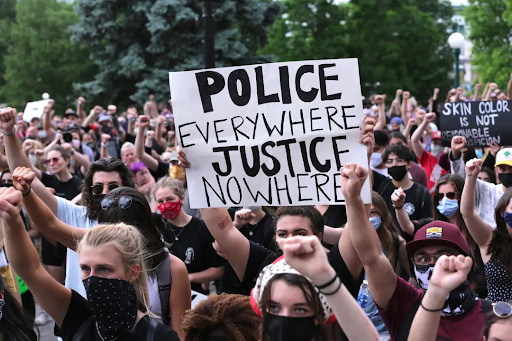
In early June 2020, protests erupted at Civic Center Park in Denver in response to George Floyd’s death and broader concerns over racism and police brutality. Photo by Hart Van Denburg/CPR News [1]
When states around the world defend their use of force against civilians, they rarely describe themselves as authoritarian. Instead, they claim to be acting democratically, and more often than not, the United States is the example they point to.
This association is the product of American exceptionalism, the belief that the United States is not merely one democracy among many, but a political system uniquely grounded in liberty, popular sovereignty, and self-governance [2]. From its founding, the United States has been celebrated as a democratic experiment unlike any before it, a state defined by a written constitution, institutional checks and balances, and government legitimacy derived from the people rather than inherited authority. These features quickly became more than innovations and instead came to serve as normative standards against which other political systems were judged.
Over time, as the United States expanded its global influence, this notion of American exceptionalism grew, and its democracy came to be seen not as one example among many, but as a model for the world. In the aftermath of World War II, for instance, the United States emerged as the dominant economic, military, and political power, and its democratic model gained unprecedented authority [3]. Additionally, by leading international institutions such as the United Nations, the International Monetary Fund, and the World Bank, the United States embedded its understanding of governance, rights, and legitimacy into the rules and language of global order [4]. Its authority only strengthened during the Cold War, when the U.S. defined itself in opposition to authoritarian and communist regimes, presenting its influence as both a defense of democracy and a standard for judging the political legitimacy of other states [5].
Today, the American regime remains the central reference for how democracy is realized in practice, shaping not only expectations of governance at home, but also what the world recognizes as proper democratic rule. Its policies and actions are closely observed and often cited abroad, especially regarding security and the use of force. Yet alongside this influence lies a striking contradiction: while the United States is widely regarded as a democratic model, its tolerance of violence against its own citizens undermines the moral authority it once claimed [6]. Police brutality has become one of the most visible and internationally recognized manifestations of this tension [7]. Particularly since the late twentieth century, with the rise of aggressive policing and the militarization of law enforcement, the United States has repeatedly demonstrated a willingness to use excessive force, engage in violent crowd control, and allow the killing of civilians by police. These practices are extensively documented by journalists, human rights organizations, and global media, yet they persist alongside regular elections, constitutional protections, and democratic self-identification [8]. In this context, police violence is no longer understood as an occasional failure or deviation; it is increasingly seen as something that can coexist with democracy itself. It is precisely this tolerance of brutality that gives the United States’ influence abroad its most dangerous effect: by allowing police brutality to persist without meaningful accountability, the United States legitimizes state violence worldwide, lowering the moral and political cost of repression and enabling governments to justify violence against civilians as compatible with democracy, security, and order.
The United States Sets the Upper Limit of Democratic Violence
When democracies around the world evaluate their own systems, they rely not on abstract ideals alone but on observable thresholds: how much violence a state can deploy against civilians before its democratic legitimacy is called into question. Because the United States occupies a uniquely authoritative position in the democratic imagination, its policing practices establish what this threshold looks like in practice. In effect, the United States sets the upper limit of democratic violence — the maximum level of force that can be exercised openly, repeatedly, and publicly against civilians while the regime remains legible as democratic. As long as American democracy survives visible brutality without institutional rupture, that brutality becomes implicitly classified as compatible with democracy itself.
The scale and persistence of police violence in the United States reveal a system in which lethal force has become routine and increasingly normalized, producing a violent pattern that has intensified rather than subsided over time. Each year, U.S. police kill over 1,000 civilians, and recent years have been particularly deadly: 2022, 2023, and 2024 rank among the deadliest on record, with 2024 accounting for more than 1,300 deaths, or nearly four every day, demonstrating that these incidents have not diminished but instead remain at historically elevated levels [9]. Beyond fatal shootings, police violence also occurs through widespread non-lethal force, as federal data from the Bureau of Justice Statistics and the FBI document hundreds of thousands of forceful interactions each year, including beatings, taser deployments, chemical agents, and K9 dog attacks, showing that such force often exceeds what is necessary for immediate safety and has become embedded in routine policing [10]. Together, this rise in American police brutality is not simply a reflection of more encounters between police and civilians but the result of structural and cultural factors that have intensified over time, including the militarization of police forces [11], policies granting officers broad discretion in the use of force [12], and political and legal frameworks that often shield officers from accountability [13].
What makes the American case uniquely consequential is that this violence is not concealed but intensely visible and globally circulated. In the United States, state violence is repeatedly captured on video and disseminated worldwide, turning domestic policing into an object of international scrutiny. The killing of George Floyd in Minneapolis in May 2020, for instance—recorded on a bystander’s cellphone and rapidly shared across platforms such as Twitter, Facebook, and Instagram—became a defining moment in global conversations about race and policing [14]. Floyd’s final words, “I can’t breathe,” echoed earlier victims of police violence and gained worldwide resonance precisely because the footage made the act impossible to ignore, helping to propel the Black Lives Matter movement into unprecedented global prominence [15]. As Congressional Progressive Caucus co‑chairs Pramila Jayapal and Mark Pocan observed, “George Floyd’s murder was not an isolated incident — but rather part of a pattern of police brutality and white supremacy that pervades our nation, and our criminal justice system in particular,” underscoring how Floyd’s death brought national focus to systemic police violence [16]. Within days, protests erupted across the United States and around the world; estimates suggest that between 15 million and 26 million people participated in demonstrations domestically, with protests reported in over 2,000 cities across more than 60 countries, making the movement one of the largest in global history [17]. Human rights organizations further documented how the state response intensified this visibility: Amnesty International recorded 125 incidents of police violence against protesters, journalists, and bystanders in 40 states, including beatings, misuse of tear gas and pepper spray, and indiscriminate firing of less-lethal projectiles—all captured on video and widely circulated online [18].
More recently, the fatal shooting of 37-year-old Renée Nicole Good by U.S. Immigration and Customs Enforcement (ICE) agents on January 7, 2026 once again demonstrated how media-driven visibility can shape public awareness of American state violence [19]. Good — a Minneapolis resident and mother of three — was shot and killed during a federal enforcement operation. A 47-second clip of the incident first appeared on X when the partisan outlet Alpha News posted footage from the ICE agent’s phone, and major news organizations and social media users quickly amplified the video across digital platforms, ensuring that it reached a broad public audience almost immediately [20]. Because videos of the incident circulated so widely — with outlets like ABC News and social media users sharing footage soon after it emerged — the visual record became central to how the event was understood and debated, challenging official narratives and directing attention to questions about ICE’s use of force. In public commentary, Human Rights Watch program director Tanya Greene underscored how the visual record of Good’s killing pierced official accounts, arguing that “the violent militarization of U.S. immigration enforcement has resulted in another brutal and senseless death,” a framing that shows how the widely shared footage challenged dominant narratives and made state violence unmistakable [21]. Because that footage circulated so broadly across social platforms and national news outlets, it reached an audience far beyond Minneapolis, and polling data from Quinnipiac University and CNN indicates that 82 percent of U.S. voters had seen the video of Good’s killing [22]. A majority of those respondents described the shooting as unjustified or inappropriate, showing how widespread media exposure helped shape public judgment about the incident. This widespread recognition quickly translated into collective action, as activists mobilized under banners such as “ICE Out for Good,” organizing more than 1,000 protest events nationwide in the days following her death—concentrated primarily in major metropolitan areas such as Minneapolis, Los Angeles, and New York, though smaller demonstrations also emerged in other regions [23].
By retaining democratic legitimacy despite highly visible, widely circulated instances of police and federal violence, the United States establishes what can be called the green-light effect: the process by which a democracy’s tolerance of public brutality signals to other states that coercive force can be exercised without threatening democratic credibility. Political theory has long recognized that states rest on a monopoly of force — what Mancur Olson described as the logic of “stationary banditry,” in which rulers maintain order through institutionalized coercion [24]. Yet liberal democracies claim a distinctive form of legitimacy grounded not only in order, but in constitutional rights, equal protection, and the rule of law. When violence becomes globally visible and normatively contested, one might expect that rights-based legitimacy would erode. High-profile cases such as the killings of George Floyd and Renée Good exemplify this tension. In both instances, video footage captured the events in stark detail, circulated rapidly across social media and international news outlets, and sparked widespread domestic and global debate. Yet despite this unprecedented visibility, U.S. democratic institutions remained intact and its global standing largely unchallenged, demonstrating that even highly visible state violence in a rights-claiming democracy does not automatically erode democratic legitimacy. Beyond these individual cases, the routine and pervasive nature of police violence — from lethal force to widespread coercion in everyday interactions — reinforces the lesson that repeated, visible use of force can coexist with recognized democracy. In this sense, the green-light effect functions as a demonstrative signal for other governments: by observing the United States, states around the world see that domestic institutions, political elites, and the international community tolerate aggressive policing, militarized enforcement, and public coercion without withdrawing democratic recognition, effectively setting an informal ceiling for acceptable force.
Legitimacy Travels, Not Tactics
While other governments do not simply copy specific policing tactics from the United States, they increasingly appear to absorb the normative lesson that visible, brutal coercion can be compatible with democratic legitimacy — a lesson derived in part from how the U.S. has repeatedly tolerated widely circulated episodes of police violence without institutional collapse. In this sense, what travels from the U.S. example is not the precise tactics of policing, but a moral and political benchmark for judging when force against civilians can be socially and politically normalized. Across diverse contexts, from South America to Europe to Asia, the U.S. example shapes how governments calibrate coercion, embedding a transnational standard for what citizens may endure under the guise of democracy.
In France, the politics of police violence illustrates how this legitimation script has been learned and deployed in a context where force was already contested before the global spotlight turned to the United States. Long before 2020, French authorities faced international censure for the use of heavy crowd-control tactics during domestic demonstrations. In 2019, United Nations human rights experts expressed deep concern over the French government’s handling of the Yellow Vest protests, noting a “pattern of excessive use of force” and receiving reports of 1,700 “serious injuries caused by crowd-control weapons” [25]. According to a subsequent report by Amnesty International, French law enforcement fired at least 19,071 rubber bullets and deployed thousands of grenades in 2018 and 2019 alone, causing severe injuries to protesters and bystanders alike [26]. At that stage, however, such violence still provoked sustained legitimacy anxiety, with international scrutiny focused on whether French policing was drifting outside democratic norms.
The killing of George Floyd in the United States in 2020, however, marked a turning point not by introducing police violence to France, but by resetting the global expectations of what democracies could withstand without delegitimation. Floyd’s murder became a referential lens for French citizens and activists. As PBS News reported, demonstrations in Paris and other French cities drew on slogans such as “I can’t breathe,” explicitly linking French police conduct to the global discourse catalyzed by American police brutality [27]. Yet the more consequential shift occurred at the level of the state. When similar violence erupted again after the June 2023 killing of 17-year-old Nahel Merzouk — another incident captured on a bystander’s smartphone and widely circulated — the French government escalated its response with markedly greater scale and confidence [28]. Interior Minister Gérald Darmanin deployed roughly 45,000 officers nationwide, emphasizing law and order and framing the unrest as a public security crisis rather than a democratic failure [29]. What this sequence reveals is an indirect but powerful relationship: after the United States demonstrated that filmed police killings need not threaten democratic legitimacy, France escalated coercive policing in response to visible violence with far less concern that legitimacy itself was at stake.
The United Kingdom, long known for its more restrained policing compared to the United States, nonetheless exhibits a similar post-2020 shift in how visible coercion is tolerated and expanded. Official data from the Home Office show that police forces in England and Wales recorded 747,396 use-of-force reports in the year ending March 2024, up about 13 percent from the previous year, with a 10 percent rise in total incidents even after accounting for data recording improvements [30]. In the subsequent year to March 2025, use-of-force incidents continued to climb, reaching an estimated 812,449 reports, according to legal analysis of newly released statistics [31].
The policing of the 2021 Sarah Everard vigil demonstrates how the post-George Floyd U.S. experience operated as a permissive reference point for British authorities. Just one year after global protests condemned the visible use of police force in the United States, Metropolitan Police officers forcibly dispersed a peaceful vigil and physically restrained mourners, despite the event’s exceptional symbolic importance and international visibility, particularly given that Everard had been murdered by a serving police officer. Senior British officials defended the intervention as a lawful and necessary enforcement of COVID-19 public health regulations, emphasizing that the gathering violated pandemic restrictions and posed transmission risks. That justification merits serious consideration, as democratic governments routinely impose temporary limits on assembly during public health emergencies. Yet the controversy did not stem solely from the existence of restrictions, but from the discretionary decision to deploy physical force against mourners at a vigil explicitly protesting police violence. The manner of enforcement — rather than the legal authority itself — raised broader questions about proportionality, judgment, and the scope of coercive power exercised in politically sensitive contexts. Rather than prompting structural reform, however, officials framed the incident as an operational response to exceptional circumstances, managing it primarily as a reputational crisis to be contained rather than as a legitimacy-threatening rupture within British democracy [32]. In this respect, the response mirrored the U.S. post-Floyd pattern, in which highly visible incidents of police violence were publicly condemned yet institutionally managed through internal investigations, legal rationalization, and rhetorical commitments to review that preserved the underlying scope of police power. Whether this framing reflects continuity or change is crucial. British authorities have historically treated controversial uses of force as challenges to public confidence rather than existential threats to democratic order, suggesting that the reputational framing itself is not entirely new. What distinguishes the post-2020 moment, however, is the altered international context: by this point, the United States had already demonstrated that even intensely visible, globally circulated police violence could coexist with sustained democratic legitimacy and international influence.
While the United Kingdom demonstrates how democracies with historically restrained policing learned that visible coercion could be politically absorbed, Brazil reveals how this recalibration operates in contexts where police violence is already lethal, allowing force to escalate under a different logic. In Brazil, the influence of the post-2020 U.S. example operated less through lessons about protest management and more through the validation of lethal policing as a legitimate tool of security governance within a democratic framework. By the early 2020s, U.S. policing discourse increasingly emphasized crime control, officer authority, and territorial dominance, with political leaders openly defending aggressive enforcement as necessary for public safety despite mounting evidence of civilian harm. This framing resonated in Brazil, where police violence had long been present but was increasingly justified through the language of operational necessity and crime suppression rather than exceptional emergency.
This shift toward treating lethal force as evidence of state capacity is most clearly visible in Operation Containment on October 28, 2025 [33]. According to figures reported by Rio de Janeiro’s Public Security Institute, approximately 2,500 military and civil police officers conducted coordinated raids across the Alemão and Penha favela complexes, deploying armored vehicles, helicopters, and high-caliber firearms in operations that resulted in over 120 deaths, making it the deadliest police action in the state’s recorded history [34]. Despite extensive documentation of unlawful killings, Brazilian state officials consistently framed Operation Containment as a necessary response to criminal threat, arguing that the scale of the operation was justified by the alleged danger posed by armed groups operating in the area. Public statements by Rio de Janeiro authorities emphasized that those killed were suspected criminals, that officers were acting to protect the broader public, and that lethal force was required to reassert state control over territory portrayed as lawless [35]. This framing closely tracks the U.S. response to George Floyd’s killing, in which officials initially justified police action by emphasizing allegations that Floyd had used a counterfeit bill, resisted arrest, or posed a threat to officers, recasting the encounter as a public safety intervention and officer risk scenario rather than an act of excessive force. In both cases, state authorities framed police violence through narratives of criminality and public danger, directing attention away from police conduct and toward the alleged necessity of force. Operation Containment was conceived and defended as a crime control intervention, mirroring the U.S. response to George Floyd’s killing in which officials emphasized alleged criminal behavior and officer risk to portray lethal force as a public safety measure. The connection between the two lies in this shared justificatory logic, where invoking security and criminal threat recasts extreme police violence as responsible governance rather than a breakdown of democratic norms.
Simon Says: Don’t Punish the Police
What connects the United States, France, the United Kingdom, Brazil, and other democracies is not merely the normalization of force, but the systematic failure of accountability mechanisms to punish police when they kill or seriously harm civilians. In the United States, this dynamic is most visible because extraordinary public scrutiny has repeatedly failed to produce structural consequences. After George Floyd’s murder, political leaders publicly acknowledged the need for reform, yet four years later Reuters reported that comprehensive federal police legislation “has largely stalled” [36], with the George Floyd Justice in Policing Act—intended to limit qualified immunity and expand federal oversight—passing the House only to collapse in the Senate [37]. The importance of this failure lies in what it preserved: qualified immunity, prosecutorial discretion, and decentralized oversight mechanisms that continue to shield officers from civil and criminal liability. Human Rights Watch has warned that when police are rarely held criminally accountable, the result is not ambiguity but instruction, sending “the message to officers that they can engage in abuses with impunity” [38]. That instruction was reinforced in the killing of Renée Nicole Good, where accountability was not denied after investigation, but foreclosed before it could begin. Minnesota’s Bureau of Criminal Apprehension publicly stated that it could not conduct a full investigation because it lacked “complete access to the evidence, witnesses and information,” revealing how jurisdictional control allows state actors to block accountability procedurally [39]. This is not an administrative failure but a structural one, in which the United States—despite its status as a globally recognized democracy—demonstrates that democratic governance can persist even as accountability for state violence remains absent, inconsistent, or politically unnecessary.
In effect, the United States operates as a global “Simon says” of democratic policing: when accountability is withheld rather than enforced, other democracies learn that restraint is optional rather than required. For instance, in France, the killing of 17-year-old Nahel Merzouk initially appeared to prompt decisive legal action, yet authoritative reporting by Le Monde shows how accountability was ultimately displaced into delay rather than enforcement [40]. Although the officer was formally charged, judicial authorities scheduled proceedings on a timeline extending into 2026, years after the killing, transforming immediate demands for justice into a prolonged legal process [41]. This delay matters because it preserves the appearance of accountability while neutralizing its deterrent effect, allowing policing practices to continue unchanged once public urgency subsides. By contrast, in the United Kingdom, accountability failed not through delay but through administrative containment. Following the policing of the Sarah Everard vigil, official responses emphasized inspection and legality rather than discipline: the Home Office commissioned a review by HMICFRS and framed the incident as an issue of operational judgment under public-health regulations [42]. Even after the High Court ruled that the Metropolitan Police had violated fundamental rights to expression and assembly, no punitive measures followed that would meaningfully narrow police discretion [43]. In this case, oversight existed, but only as evaluation, not enforcement, reinforcing the lesson that even legally unlawful police violence need not result in punishment. The same pattern becomes unmistakable at lethal scale in Brazil. After more than 120 people were killed in Operation Containment, Human Rights Watch documented “serious investigative failures,” including the failure to secure crime scenes and preserve evidence, while UN human-rights experts stressed that domestic investigative bodies lacked the independence required for credible accountability [44]. Reuters later reported that prosecutors did not identify most of those killed as suspects in the legal complaint used to justify the raid, demonstrating how mass lethal force could be defended without individualized criminal attribution or legal consequence [45].
Democracy to Democrisis
What is ultimately at stake is not the conduct of any single police force, but the future meaning of democracy itself. If democratic rule no longer requires enforceable limits on state violence, then what, exactly, distinguishes democratic authority from coercive power preserved through procedure alone? If elections, courts, and constitutional language can endure while police kill without consequence, what obligation does the state still owe to those it governs? The American example has made these questions unavoidable by showing the world that legitimacy can survive brutality, that accountability can be deferred indefinitely, and that democracy can remain globally recognized even as restraint collapses. As this lesson circulates, it reshapes global expectations, teaching governments not how to govern justly, but how to govern forcefully without consequence. The danger, then, is not a sudden democratic collapse, but a slow and systemic transformation—one in which repression becomes compatible with democracy, restraint becomes optional, and violence becomes administratively normal. This is the democrisis of our moment: a world in which democracy endures not by limiting power, but by learning how far it can go.
Sources
[1] Swidler, Francie. “Colorado Tried to Reform Police after Last Summer’s Protests. Here’s How.” Colorado Public Radio, April 27, 2021. https://www.cpr.org/2021/04/27/colorado-tried-to-reform-police-after-last-summers-protests-heres-how/.
[2] Volle, Adam. “American Exceptionalism.” Encyclopaedia Britannica, December 31, 2025. https://www.britannica.com/topic/American-exceptionalism.
[3] Burton, Kristen D., PhD. “Great Responsibilities and New Global Power.” The National WWII Museum, October 23, 2020. https://www.nationalww2museum.org/war/articles/new-global-power-after-world-war-ii-1945.
[4] Woods, Ngaire. “The United States and the International Financial Institutions: Power and Influence Within the World Bank and the IMF.” In US Hegemony and International Organizations: The United States and Multilateral Institutions, edited by Rosemary Foot, S. Neil MacFarlane, and Michael Mastanduno, 92–114. Oxford: Oxford University Press, 2003. https://academic.oup.com/book/9499/chapter/156462859.
[5] Burton, “Great Responsibilities and New Global Power.”
[6] Hasbrouck, Brandon. “Unshielded: How the Police Can Become Touchable.” Harvard Law Review 137, no. 3 (January 2024): 895-934. https://harvardlawreview.org/print/vol-137/unshielded-how-the-police-can-become-touchable/.https://harvardlawreview.org/print/vol-137/unshielded-how-the-police-can-become-touchable/.
[7] Succar, Rayan, et al. “Understanding the Role of Media in the Formation of Public Sentiment Towards the Police.” Nature (2024). https://www.nature.com/articles/s44271-024-00059-8.
[8] Succar et al., “Understanding the Role of Media in the Formation of Public Sentiment Towards the Police.”
[9] Mapping Police Violence. Mapping Police Violence. Updated January 29, 2026. https://mappingpoliceviolence.org/.
[10] Levin, Sam. “US Police Use Force on 300,000 People a Year, with Numbers Rising Since George Floyd: ‘Relentless Violence.’” The Guardian, August 28, 2024. https://www.theguardian.com/us-news/article/2024/aug/28/police-use-of-force-violence-data-analysis.
[11] Rolle, Kimberly. “The Militarization of US Law Enforcement and Civilian Harm.” Center for Civilians in Conflict, January 13, 2021. https://civiliansinconflict.org/blog/the-militarization-of-us-law-enforcement-and-civilian-harm/.
[12] Slobogin, Christopher, and Brandon Garrett. “The Law on Police Use of Force in the United States.” German Law Journal 21, no. 8 (December 2020): 1526–1546. Vanderbilt Law School Faculty Publications. https://scholarship.law.vanderbilt.edu/faculty-publications/1157/.
[13] Blum, Karen. “Qualified Immunity: Achieving a Better Balance.” Boston Bar Journal 69, no. 1 (Winter 2025). https://bostonbar.org/journal/qualified-immunity-achieving-a-better-balance/.
[14] Hughes, Samuel. “Social Media Case Study: The Killing of George Floyd.” The Institute of Strategic Risk Management, n.d. https://www.theisrm.org/social-media-case-study-the-killing-of-george-floyd/.
[15] Hughes, “Social Media Case Study: The Killing of George Floyd.”
[16] Congressional Progressive Caucus. “Congressional Progressive Caucus Statement on the Killing of George Floyd.” Congressional Progressive Caucus, May 27, 2020. https://progressives.house.gov/2020/5/congressional-progressive-caucus-statement-on-the-killing-of-george-floyd/.
[17] Chenoweth, Erica. “Black Lives Matter May Be the Largest Movement in U.S. History.” Harvard Kennedy School Carr Center for Human Rights Policy, July 3, 2020. https://www.hks.harvard.edu/centers/carr/publications/black-lives-matter-may-be-largest-movement-us-history.
[18] Amnesty International. “USA: Unlawful Use of Force by Police at Black Lives Matter Protests.” Amnesty International, June 23, 2020. https://www.amnesty.org/en/latest/news/2020/06/usa-unlawful-use-of-force-by-police-at-black-lives-matter-protests/.
[19] Wertheimer, Tiffany. “Renée Nicole Good: Who Was the Woman Killed by Federal Immigration Agent in Minneapolis.” BBC News, January 13, 2026. https://www.bbc.com/news/articles/c1jepdjy256o.
[20] Vargas, Ramon Antonio. “Renee Nicole Good Said ‘I’m Not Mad at You’ Before ICE Agent Shot Her, Video Shows.” The Guardian, January 9, 2026. https://www.theguardian.com/us-news/2026/jan/09/ice-agent-minneapolis-bodycam-footage.
[21] Human Rights Watch. “US: Killing of Minneapolis Woman by ICE.” Human Rights Watch, January 8, 2026. https://www.hrw.org/breaking-news/2026/01/08/us-killing-of-minneapolis-woman-by-ice.
[22] ABC7 Chicago. “Minneapolis ICE Shooting Live Updates.” ABC7 Chicago, January 19, 2026. https://www.abc7.com/live-updates/minneapolis-ice-shooting-live-updates/18410867/entry/18416374/.
[23] Reddit. “Nationwide Anti-ICE Protests Call for Accountability After Renee Good’s Death.” r/Defeat_Project_2025, Reddit, January 2026. https://www.reddit.com/r/Defeat_Project_2025/comments/1qa0yg8/nationwide_antiice_protests_call_for/.
[24] Olson, Mancur. Power and Prosperity: Outgrowing Communist and Capitalist Dictatorships. New York: Basic Books, 1999.
[25] Office of the United Nations High Commissioner for Human Rights. “France: UN Experts Denounce Severe Rights Restrictions on ‘Gilets Jaunes’ Protesters.” OHCHR, February 14, 2019. https://www.ohchr.org/en/press-releases/2019/02/france-un-experts-denounce-severe-rights-restrictions-gilets-jaunes.
[26] Amnesty International. France: Arrested for Protest: Weaponizing the Law to Crackdown on Peaceful Protesters in France (Index: EUR 21/1791/2020), September 29, 2020. https://www.amnesty.org/en/documents/eur21/1791/2020/en/.
[27] le Deley, Jade and Lori Hinnant. “Thousands of Teens Have Been Arrested in French Protests, Though Violence Is Subsiding.” PBS NewsHour, July 6, 2023. https://www.pbs.org/newshour/world/thousands-of-teens-have-been-arrested-in-french-protests-though-violence-is-subsiding.
[28] Chappell, Bill. “France Is Roiled by Protests after Police Killed a Teenager. Here’s Why.” NPR, updated July 1, 2023, 9:21 PM ET. https://www.npr.org/2023/06/30/1185394143/france-teen-police-shooting-protests-nahel.
[29] A News. “France Says Deploying 45,000 Police to Deal with Night Rioting.” A News, June 30, 2023. https://www.anews.com.tr/europe/2023/06/30/france-says-deploying-45000-police-to-deal-with-night-rioting.
[30] Home Office. Police Use of Force Statistics, England and Wales: April 2023 to March 2024. GOV.UK, December 5, 2024. https://www.gov.uk/government/statistics/police-use-of-force-statistics-april-2023-to-march-2024/police-use-of-force-statistics-england-and-wales-april-2023-to-march-2024.
[31] Home Office, Police Use of Force Statistics, England and Wales: April 2023 to March 2024.
[32] Police Professional. “MPS Acted Appropriately at the Sarah Everard Vigil, HMICFRS Report Finds.” Police Professional, March 30, 2021. https://policeprofessional.com/news/mps-acted-appropriately-at-the-sarah-everard-vigil-hmicfrs-report-finds/.
[33] Hughes, Eléonore, and Diarlei Rodrigues. “Protests Erupt after Police Raid in Brazil Leaves 119 Dead and Draws Accusations of Excessive Force.” Associated Press, updated October 29, 2025. https://www.apnews.com/article/brazil-favela-deaths-f2e7366d98790c5c90e7996ec8b3282f.
[34] Hughes and Rodrigues, “Protests Erupt after Police Raid in Brazil Leaves 119 Dead and Draws Accusations of Excessive Force.”
[35] Reuters. “Deadly Rio Police Operation Was ‘Legitimate Action,’ Official Says.” Reuters (video), October 30, 2025. https://www.reuters.com/video/watch/idRW792729102025RP1/.
[36] Reuters, “Rio Police Operation.”
[37] H.R. 1280, George Floyd Justice in Policing Act of 2021, 117th Cong. (2021). https://www.congress.gov/bill/117th-congress/house-bill/1280.
[38] Human Rights Watch. Shielded from Justice: Police Brutality and Accountability in the United States. New York: Human Rights Watch, July 1, 1998. https://www.hrw.org/legacy/reports98/police/uspo14.htm.
[39] Associated Press and TEGNA Digital. “FBI Cuts Minnesota Officials’ Access to Investigation of Fatal ICE Shooting.” KVUE, published January 8, 2026, 11:21 AM CST, updated January 8, 2026, 2:35 PM CST. https://www.kvue.com/article/news/nation-world/minneapolis-ice-shooting-fbi-cuts-off-state-official-access/507-828c3722-f64b-4699-9982-4efef3ccc164.
[40] Le Monde with AFP. “French Police Officer Who Shot Teenager Nahel M. Dead Will Be Tried for Murder.” Le Monde, June 3, 2025, updated June 3, 2025. https://www.lemonde.fr/en/police-and-justice/article/2025/06/03/french-policeman-who-shot-nahel-m-to-go-on-trial-for-murder_6741963_105.html.
[41] Le Monde with AFP, “French Police Officer Who Shot Teenager Nahel M. Dead Will Be Tried for Murder.”
[42] Police Professional, “MPS Acted Appropriately at the Sarah Everard Vigil, HMICFRS Report Finds.”
[43] Middleton, Theodora. “Met Police Violated Human Rights in Thwarting Reclaim These Streets Vigil.” Legal Action, March 20, 2022. https://www.lag.org.uk/article/212477/met-police-violated-human-rights-in-thwarting-reclaim-these-streets-vigil.
[44] Human Rights Watch. “Brazil: Serious Investigative Failures in Deadly Rio Raid.” Human Rights Watch, October 31, 2025. https://www.hrw.org/news/2025/10/31/brazil-serious-investigative-failures-in-deadly-rio-raid.
[45] Ricardo Brito and Luciana Novaes Magalhães. “Brazil’s Deadliest Police Raid Failed to Capture or Kill Gang Leaders.” Reuters, November 10, 2025. https://www.reuters.com/world/americas/brazils-deadliest-police-raid-failed-capture-or-kill-gang-leaders-2025-11-10/.