
The Politics of the Veil: Laïcité and the Scapegoating of Islam
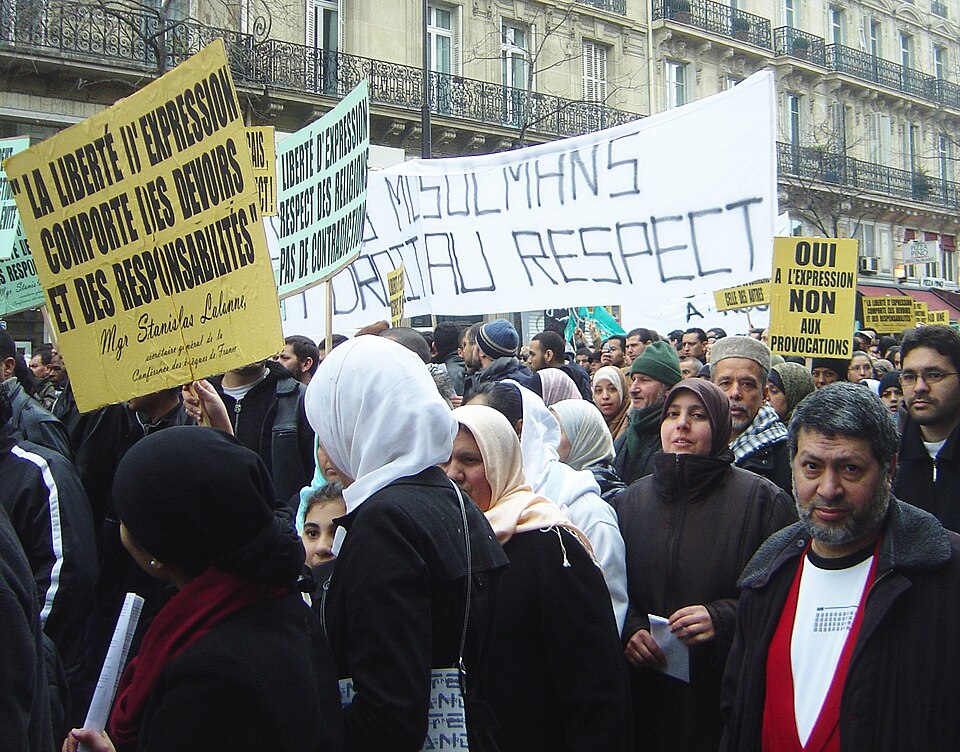
In October 1989, a French middle school expelled three young Muslim girls for refusing to remove their hijabs in school. The event sparked a major debate, eventually leading to a 2004 ban on all conspicuous religious symbols in public schools. In 2010, France became the first European country to ban full-face veils like the burqa and niqab in public spaces [1]. In 2021, centrist French President Emmanuel Macron signed a bill against “Islamist separatism,” the supposition that Muslims are the “enemy of the people” for having an agenda to create a second society against France’s secular democracy [2]. The bill significantly widens the scope of the ban on religious symbols, such that parents who wear religious clothing could not attend school trips. This bill expanded prohibition to private contractors of public services despite there previously being a “neutrality principle” that prohibits public servants from wearing religious symbols. [3]. Though the bill never explicitly mentions “Muslim”, Macron presents it as a solution to the “crisis of Islam” [4]. This crisis encapsulates both France’s struggle with Islamist terrorism and the belief that Islam is facing an internal crisis.
France’s road to enlightenment differs from Britain's or the United States’ in that it demands separating faith and reason, rather than finding harmony between the two, culminating in the principle of laïcité. As France’s strictest form of secularity, laïcité goes beyond separating religion from politics by confining religion to the private sphere. It does not protect religion from state interference. Rather, the state holds an important role in preventing the infringement of religion [5]. Thus, France leverages laïcité to substantiate policies constraining religion. Though the 2004 law seems enshrined in a historical French principle that purports “neutrality” by being applicable to all public servants, critics assert that it disproportionately affects Muslim women. The law encroaches upon their freedom of religion and expression. These laws are a legacy of colonialist attitudes and a desire to homogenize the country. Leaders use them to serve their political agenda: rallying populist, ethnonationalist hatred towards Islam as a racialized religion.
France has a strong colonial past in North Africa, specifically in Tunisia, Morocco, and Algeria, known collectively as the Maghreb. Algeria experienced the most repressive colonial rule and a violent struggle for independence [6]. France's requirement that Muslim women take their hijab off in public parallels its imperial actions in the Maghreb. For example, the unveiling ceremonies for Muslim women in Algeria: a public spectacle which serves to “emancipate” women. France equated the veil with backwardness and wanted French women to adhere to a French secular lifestyle [7]. Therefore, we can understand today’s determination to “civilize” and “enlighten” as a legacy of colonial ideology. France still believes that abandoning the veil is the panacea to radical Islamism. Furthermore, assimilation is central to France’s colonial history, with France forcing Maghrebi women to adopt the slogan “Let’s be like the French woman” as they were unveiled [8]. France’s colonialism has always been about absorbing its subjects [9]. Macron’s anti-separatist bill similarly reframes assimilation as liberation by secularizing and reforming Islam. Inflammatory media discourse stereotypes Muslim women as submissive and oppressed by the hijab and therefore, by extension, men. An amendment to the anti-separatist bill of 2021 implicitly identifies the hijab as a symbol of “inferiority of women over men” [10]. As a result, French women feel that the hijab is an affront to their interpretation of feminism. French women believe in their work to assimilate Muslims because they perceive them as culturally alien, despite the fact that many of them are born and raised in France. Not only does this domestication of Muslim women reinforce cultural divisions, it also infringes on their rights to freedom of conscience. Yet, as is inherent to colonial theory, notions of freedom hinge upon who is accepted into society and who is not [11]. The privileged status group — native non-Muslim French — makes those decisions. This group presents two options: to remain veiled and ostracized, or to be unveiled and integrated into French society.
Amidst the rise of ISIS and other radical Islamic groups, many French citizens have come to see multiculturalism and immigration as a plague. Not only did Europol, Europe’s law enforcement agency, report that France ranked first in the E.U. for the number of jihadist terrorist incidents, but the horror of the attacks — such as the beheading of a French teacher in 2020 — has developed an intense collective trauma [12]. Faced with disparate, random attacks, non-muslim French people seek to narrow down the scope of terrorism to one denomination: one group of people is easier to deal with than several. As such, the Muslim identity has been distorted and reduced to a single racial category. Hailing from diverse countries, speaking different languages, and holding various practices, Muslims have been homogenized as one group associated with terrorism and repression. In other words, the Islamic faith is racialized and seen as a visible, inheritable identity [13]. This allows leaders to justify a ban on religious clothing, as the physical characteristics of Islam are racialized and associated with terrorism.
The aim to erase Islam from the visible eye is thus an effort to construct a sense of security. Furthermore, it is a way to assuage the sentiment of indignation among the French people, who resent the diversification of France and view its pluralistic society as an affront to their national raison d’être — the government’s purpose being to protect secularism [14]. Cultural and religious homogeneity is a palatable narrative of far-right ideology. This narrative allows it to enter mainstream discourse at a time when people are disenchanted with traditional or left-wing political measures. Driven by economic anxieties and resentment towards immigration and globalization, many citizens are discontent with Macron [15]. Whereas a policy that promises to protect against immigration, ensure cultural identity, and find economic stability used to communicate xenophobia, it is now embraced as long-overdue control [16]. Indeed, the President of the far-right national party, Marine Le Pen, used this rhetoric to rebrand the originally fringe party, Le Front National, and successfully broaden its appeal [17].
These narratives represent typical populist methodology. Populism irrationally and illogically conflated a small-scale phenomenon of Muslim women wearing head coverings with larger issues of terrorism. Indeed, a 2019 study revealed that no women wore the burqa and only 1,900 wore the niqab, accounting for 0.00003 percent of the French population and 0.04 percent of the French Muslim population at that time [18]. Yet, Muslim women from the Maghreb are blamed for supplanting French jobs, even though they have a lower rate of labor force participation than French-born women [19, 20]. It is central to populist rhetoric to pit the national majority against a minority. In this case, Muslims have borne the burden of poor economic conditions, terrorism, and national division. Xenophobia often accompanies periods of economic slumps, and leaders harness hateful sentiments to mobilize support [21]. For example, in 2013, then-President Francois Hollande, facing historically low approval ratings, publicly proposed to ban the burqa in an effort to appeal to anti-Muslim attitudes [22].
Populists employ a strategy of racializing a group of people. Discourses of threat construct fear, build resentment, and produce a sense of unity among the ‘true’ national people [23]. French right-wing populists seek simple answers by constructing scapegoats and enemies. This “enemy” is often painted by taking advantage of racial stereotypes and ethnonationalism.
Overall, efforts to prohibit conspicuous religious clothing in France fit into a broader context of rising nationalism and enduring post-colonialism. By incorporating populist rhetoric of “othering,” leaders in France effectively racialize the Muslim population into a terrorist race that threatens the French Republic. Its postcolonial attitude of saving oppressed Muslim women entails coercing women into integrating rather than coexisting or accommodating. In the Rousseauist spirit, France “forces people to be free”.
Indeed, many aspects of this convoluted issue are marked by paradoxes. France defends the right to blaspheme God but treats its own deity — a secular republic — as nearly inviolable. This puts the notion of France and laïcité as paragons of freedom into question. Countering religious conflict by endeavoring to erase religion only strengthens communal identity and incites protectionist sentiments that allow radical groups to entrench cultural polarization. To move forward, France may need to redefine freedom to reconcile visibility with social cohesion. A freedom available to all does not need to look the same for everyone: it will cultivate a universal, uniform appreciation for the institution that enshrines such liberty regardless.
Sources
[1] Erlanger, Steven. “France Enforces Ban on Full-Face Veils in Public”. The New York Times. April 11th, 2011. https://www.nytimes.com/2011/04/12/world/europe/12france.html
[2] Yeung, Peter. “France’s Controversial ‘Separatism’ Bill: Seven Things to Know.” Al Jazeera. February 15th, 2021. https://www.aljazeera.com/news/2021/2/15/frances-controversial-separatism-bill-explained.
[3] Yeung, “France’s Controversial ‘Separatism’ Bill”
[4] Kebsi, Jyhene. “Unveil Them to Save Them: France and the Ongoing Colonization of Muslim Women’s Bodies.” Berkley Center for Religion, Peace, and World Affairs. May 13th, 2021. https://berkleycenter.georgetown.edu/responses/unveil-them-to-save-them-france-and-the-ongoing-colonization-of-muslim-women-s-bodies.
[5] Cohen-Almagor, Raphael. “Indivisibilité, Sécurité, Laïcité: The French Ban on the Burqa and the Niqab.” Springer Nature. October 19th, 2021. https://doi.org/10.1057/s41253-021-00164-8.
[6] Chtatou, Mohamed. “An Overview Of French Colonialism In The Maghreb – Analysis.” Eurasia Review. March 5th. 2019. https://www.eurasiareview.com/05032019-an-overview-of-french-colonialism-in-the-maghreb-analysis/.
[7] Kebsi, “Unveil Them to Save Them:”
[8] Kebsi, “Unveil Them to Save Them:”
[9] Cohen-Almagor, “Indivisibilité, Sécurité, Laïcité”
[10] Kebsi, “Unveil Them to Save Them:”
[11] Manza, Jeff. “The Sociology Project 3 - 0 Introducing The Sociological.” New York University Department of Sociology. n.d. https://www.scribd.com/document/818042834/The-Sociology-Project-3-0-Introducing-the-Sociological-Jeff-Manza-3-2023-Cengage-9780135685303-04f4da89464d91e8fbb5053e2a24dd31-Ann.
[12] Zinigrad, Roman, and Stephen W. Sawyer. “State and Religion: The French Response to Jihadist Violence.” MDPI. August 7th, 2023. https://doi.org/10.3390/rel14081010.
[13] Association for Critical Sociology. “The Racialization of Muslims: Empirical Studies of Islamophobia.” Sage Journals. July 7th, 2014. https://doi.org/10.1177/0896920514531606.
[14] Cohen-Almagor, “Indivisibilité, Sécurité, Laïcité”
[15] Berlinger, Joshua. “Why Is the Far Right Gaining Ground in France?” Al Jazeera. https://www.aljazeera.com/features/2023/12/17/why-is-the-far-right-gaining-ground-in-france.
[16] Alouane, Rim-Sarah. “France’s Far-Right Renaissance: A New Era of Political Upheaval in Europe.” Friends of Europe. July 4th, 2024. https://www.friendsofeurope.org/insights/critical-thinking-frances-far-right-renaissance-a-new-era-of-political-upheaval-in-europe/.
[17] Alouane, Rim-Sarah. “France’s Far-Right Renaissance”
[18] Cohen-Almagor, “Indivisibilité, Sécurité, Laïcité”
[19] Montenegro, Emi. “Laïcité and the Discrimination of Maghrebi Muslims in France (2019).” Seattle University Scholarworks. 2019. https://scholarworks.seattleu.edu/intl-std-theses/11.
[20] Kurić, Đermana. “ENAR Forgotten Women Report: The Impact of Islamophobia on Muslim Women.” Academia. n.d. https://www.academia.edu/30449522/ENAR_Forgotten_Women_report_The_impact_of_Islamophobia_on_Muslim_women.
[21] Montenegro, “Laïcité and the Discrimination of Maghrebi Muslims in France”
[22] Montenegro, “Laïcité and the Discrimination of Maghrebi Muslims in France”
[23] Wodak, Ruth. “The Politics of Fear: What Right-Wing Populist Discourses Mean.” ResearchGate. October, 2015. https://www.researchgate.net/publication/282572733_The_Politics_of_Fear_What_Right-Wing_Populist_Discourses_Mean.
Image: Monniaux, David. “February 11, 2006 Parisian Protest Against the Publication of Caricatures of Muhammad” February 11th, 2006.