
The Cost of the Constitutional Right to Guns
The United States has more mass shootings than any other country in the world, with 408 mass shootings in 2025 alone [1]. In 2025, 4,458 children and teenagers were shot, 1,256 of whom lost their lives. Firearms are the leading cause of death for Americans under 18 [2]. Americans are accustomed to mass shootings, while the rest of the world looks on in disbelief. One result of these frequent events is the “thoughts and prayers” cycle, where politicians express their best wishes to those affected by mass shootings without any intent to institute meaningful change through legislation. Many attribute the problem of gun violence to mental health, while others turn to the accessibility of weapons in the country. However, this article concludes that the Second Amendment of the United States Constitution, which legalizes gun access with few barriers, is the primary cause of mass shootings. The second amendment states that “a well regulated militia, being necessary to the security of a free State, the right of the people to keep and bear Arms, shall not be infringed” [3].
A helpful method in determining the truth about gun violence is that of the method of difference. John Stuart Mill, a 19th century century English philosopher and politician created the method of difference. He hypothesized that the way to determine causation is by comparing two cases that are identical except for a singular key factor. If the outcome is different between the two cases, the factor that differs is likely to be the cause of that outcome [4]. In this case, the UK was determined to be the best country for comparison because it was similar to the United States in key areas, including democratic regime type, level of development, stable rule of law, and the proportion of individuals experiencing mental health conditions. By referencing these consistent factors, the primary difference that is isolated is their constitutional structures. The benefit of this method is that because the most relevant variables are similar, any difference in outcomes can be clearly attributed to the variation in constitutional design.
To better understand the impact of constitution structures, it is necessary to look into the United Kingdom in more depth. The United Kingdom’s constitution is not a single legal source. Instead, the Acts of the UK Parliament, Conventions, Common Law, and authoritative works make up the UK’s uncodified constitution [5]. In other words, this means that constitutional laws are not afforded higher legal status than criminal or civil law. This legal system gives substantial power to the parliament, who can make or unmake any law without being limited by the constitution [6].The benefit of this system is that the law is flexible and allows for simplified procedures when the need for amendments arises.
This allows the parliament to quickly respond to national crises, like mass shootings, with productive and impactful legislation that leads to impactful change. Following the Dunblane Mass Shooting in 1996, which left 17 dead and 15 injured, the UK passed the 1997 Firearms Act [7]. The policy banned the private ownership of most handguns, semi-automatic weapons, and required mandatory registration for shotgun owners. A group of local mothers who formed the Snowdrop Campaign drove this legislation with the singular objective of banning handguns in the U.K [8]. By the fall of 1996, they collected 705,000 signatures in favor of this goal, prompting the government to start the policy process. The UK constitution does not guarantee a right to bear arms, so the legislative bodies of the government were able to pass this act in less than a year after the mass shooting occurred. Since the legislation’s passing, there have been no mass shootings in the UK. Additionally, there have been a lower number of gun deaths recorded in general [9]. The 1997 Firearms Act has provided the safety that many civilians demanded and has had a clear positive impact on British society.
On the other hand, the United States’ constitution is far different. All branches and levels of government, as well as their distinct powers and citizens’ individual rights are outlined on a singular legal document that has only been amended 27 times [10]. The second amendment guarantees all citizens the right to bear arms and keep well formed militias. This was very important at the time because the people wanted freedom to stop a tyrannical government on their own and provide their communities with safety. The government was still in its early stages, and people needed safeguards in place to feel more confident in its ability to fairly govern. Additionally, due to the early colonists of the United States living in vastly different parts of the country, this meant there was no centralized police force to provide safety to communities, so that responsibility fell to individuals themselves. However, the needs and desires of citizens are much different today. Most Americans live under an established federal system with professional law enforcement agencies, a formidable military, and stable government institutions that protect public safety. As a result, many citizens rely on the institutional systems of security, which reflect a shift away from expectations that individuals must safeguard themselves against threats. With this in mind, people continue to question the relevance of the Second Amendment today, but unlike the UK, adjusting this amendment requires the approval of both houses of Congress and the approval of a majority of states. Currently, with a diverse range of opinions on the issue across the nation, this is unlikely to occur [11].
Thus, under current Supreme Court precedent, a law similar to the UK’s 1997 Firearms Act would be deemed unconstitutional. In the case of District of Columbia v. Heller (2008), the Court struck down Washington DC’s near-total ban on handgun possession [12]. They based this ruling on the fact that the Second Amendment protects an individual’s right to possess handguns for self-defense within the home. Later on, in the case of McDonald v. City of Chicago (2010), the Supreme Court struck down Chicago’s restrictive gun laws, saying it violated the fundamental rights enshrined in the Second and Fourteenth Amendments [13]. It is important to note that the court does acknowledge the limits of the Second Amendment, banning firearm possessions by felons and those suffering from mental illness. However, the UK’s 1997 Firearms Act would still conflict with previous precedents previously established, providing constitutional barriers that are hard to navigate successfully.
Keeping this in mind, substantial change requires a constitutional amendment or a new Supreme Court precedent. While an amendment would provide the most subtle change for restricting the right to own firearms, it would still require approval from two-thirds of Congress and three-quarters of the states, which is currently politically impossible to achieve. However, this situation is unlikely as the National Rifle Association (NRA), a group that refuses to sign on to any gun control legislation, funds many Republican, Democrat, and Independent political campaigns [14]. The NRA is a recreational group that promotes rifle shooting and has become one of the most powerful political organizations in the US. Given that the NRA foundationally believes that every American should have access to guns, they have a vested interest in preventing any gun control laws from passing, so they spent $4.2 million in 2021 alone on lobbying to ensure that gun control legislation is not passed [15]. No singular major gun control bill has been passed in Congress since the 2012 Sandy Hook Massacre [16]. Alternatively, the Supreme Court could re-interpret the scope of the Second Amendment with a new case, as they are given the ability to continually redefine the applications of the Constitution. Until major institutional barriers are lifted, the Second Amendment remains a structural constraint on comprehensive federal gun control legislation that would effectively limit mass shootings.
But, hope is not lost. Just as the people in the UK demanded their legislators take action, the US can do the same. Civilians can email or call their legislators and petition them to sign onto meaningful gun policy. From domestic gun violence prevention bills, home printed gun scrutiny, and expanding background checks, there are a range of policy responses that may appeal to different political parties. If people can communicate to their politicians that they would approve of these different measures, perhaps they will vote in favor of them.
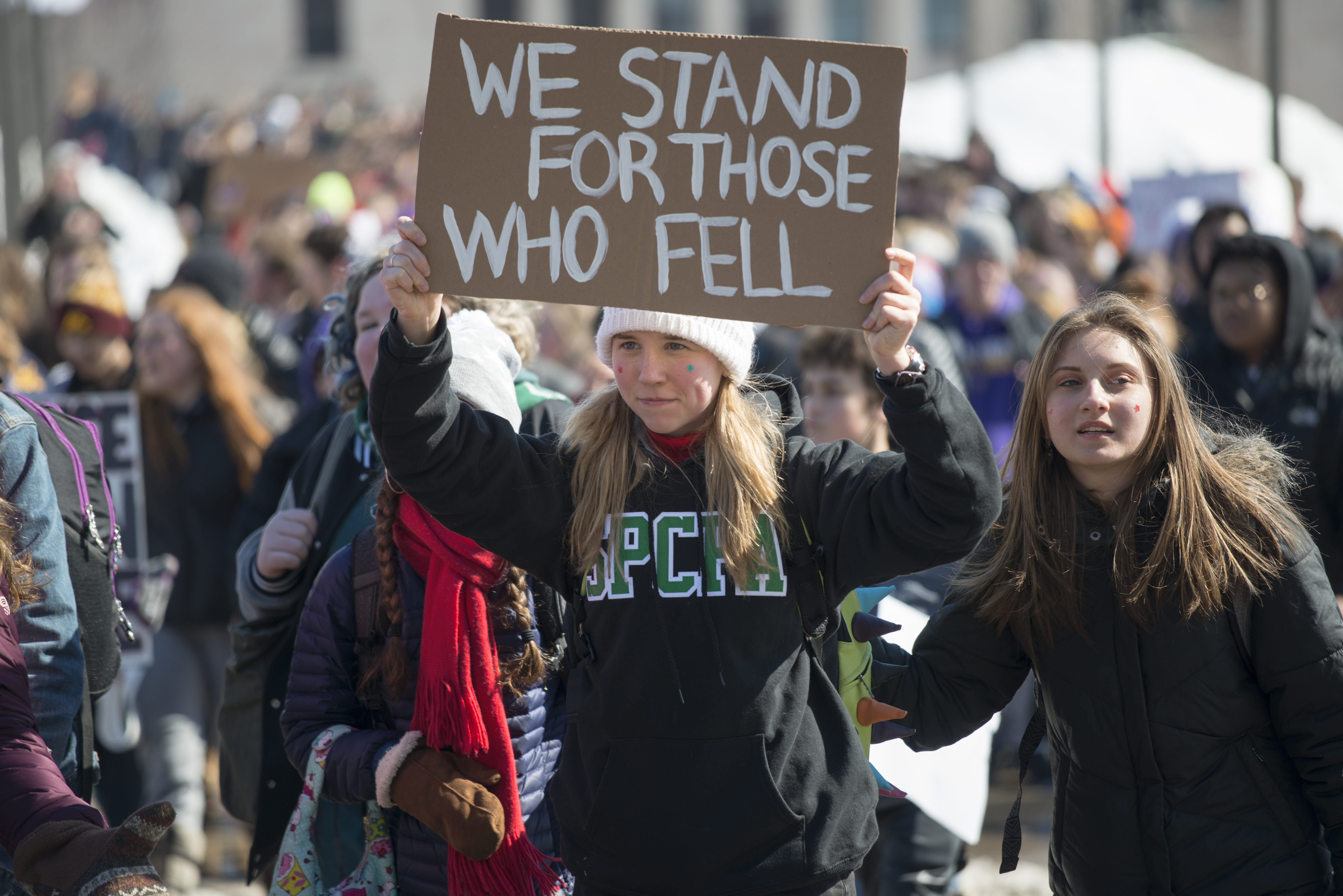
Additionally, demonstrating in peaceful protests can send a powerful message. In the “March for Our Lives” protest, over 500,000 people rallied across the country to demand tougher gun control measures after the Stoneman Douglas High School shooting that killed 17 people [17]. In response, Florida passed gun safety laws and the federal government passed the bipartisan Safer Communities Act, which was the first major federal gun control bill in decades [18]. There are some days where individuals feel powerless and their voices unanswered, but it is important to remember that individuals can enact meaningful change in their own ways. The US may still have a long way to go when it comes to sensible gun control policy, but each step forward leads to more lives being saved.
Sources
Image: “March For Our Lives student protest for gun control [photograph]”. Flickr. March 24, 2018. https://www.flickr.com/photos/44550450@N04/39786581715
[1] Curt Merill, “Visualizing how mass shootings in 2025 compare with past years,” CNN, December 15, 2025, https://www.cnn.com/us/mass-shootings-2025-vs-past-years-dg.
[2] Chip Brownlee, “Gun Violence by the Numbers in 2025,” The Trace, December 31, 2025, https://www.thetrace.org/2025/12/data-shooting-stats-gun-violence-america/.
[3] Legal Information Institute, “Second Amendment,” Constitution Annotated, https://constitution.congress.gov/constitution/amendment-2/
[4] Jay Steinmetz, “Chapter 9: Public Law and Pre-Law Training,” Politics, Power, and Purpose: An Orientation to Political Science, 2019 https://fhsu.pressbooks.pub/orientationpolisci/chapter/chapter-9-public-law-and-pre-law-training/#:~:text=The%20method%20involves%20analyzing%20the,institution%2C%20behavior%2C%20or%20policy.
[5] “The UK constitution," Constitution Society, Accessed January 28, 2026, https://consoc.org.uk/the-constitution-explained/the-uk-constitution/.
[6] “The UK constitution"
[7] Ari Shapiro, “In Britain, it took just one school shooting to pass major gun control,” NPR, June 1, 2022, https://www.npr.org/2022/06/01/1102239642/school-shooting-dunblane-massacre-uvalde-texas-gun-control.
[8] Will Tooke, “How a Group of Moms Helped Ban Handguns,” Yahoo News, July 7, 2022, https://www.yahoo.com/news/group-moms-helped-ban-handguns-183503070.html.
[9] David Barnett, “Firearms Act: Twenty years on, has it made a difference?,” The Independent, December 17, 2017, https://www.independent.co.uk/news/long_reads/firearms-act-twenty-years-on-has-it-made-a-difference-dunblane-port-arthur-a8110911.html.
[10] National Constitution Center, “The Constitution,” National Constitution Center, https://constitutioncenter.org/the-constitution
[11] Jenn Hatfield, “How U.S. Public Opinion Has Changed in 20 Years of Our Surveys,” Pew Research Center, September 13, 2024, https://www.pewresearch.org/2024/09/13/how-us-public-opinion-has-changed-in-20-years-of-our-surveys/
[12] Justia U.S. Supreme Court Center, “Distribution of Columbia v. Heller, 554 U.S. 570 (2008),” Justia, accessed March 1, 2026, https://supreme.justia.com/cases/federal/us/554/570/.
[13] James J. Williamson, “Staring Down the Sights at McDonald v. City of Chicago: Why the Second Amendment Deserves the Kevlar Protection of Strict Scrutiny,” Legislation and Policy Brief,” June 21, 2011, https://digitalcommons.wcl.american.edu/lpb/vol3/iss2/5/.
[14] Bill Barrow, “Killing of Alex Preti scrambles Second Amendment politics for Trump,” PBS, January 27, 2026, https://www.pbs.org/newshour/politics/killing-of-alex-pretti-scrambles-second-amendment-politics-for-trump.
[15] BBC News, “US Gun Control: What is the NRA and Why Is It So Powerful?,” BBC, January 8, 2016, https://www.bbc.com/news/world-us-canada-35261394.
[16] Joel Brown, “The Long, Failed History of Gun Control Legislation,” BU TODAY, May 25, 2022, https://www.bu.edu/articles/2022/the-long-failed-history-of-gun-control-legislation/.
[17] Samantha Raphelson, “Hundreds of Thousands March for Gun Control Across the U.S.,” NPR, March 24, 2018, https://www.npr.org/sections/thetwo-way/2018/03/24/596679790/hundreds-of-thousands-march-for-gun-control-across-the-u-s.
[18] Marek Dziobak, “#NeverAgainMSD and the March for Our Lives Movement: American Youth for Gun Control,” Ad Americam, November 24, 2023, https://journals.akademicka.pl/adamericam/article/view/5466.