
The Blurred Boundary Between Immigration Enforcement and Policing
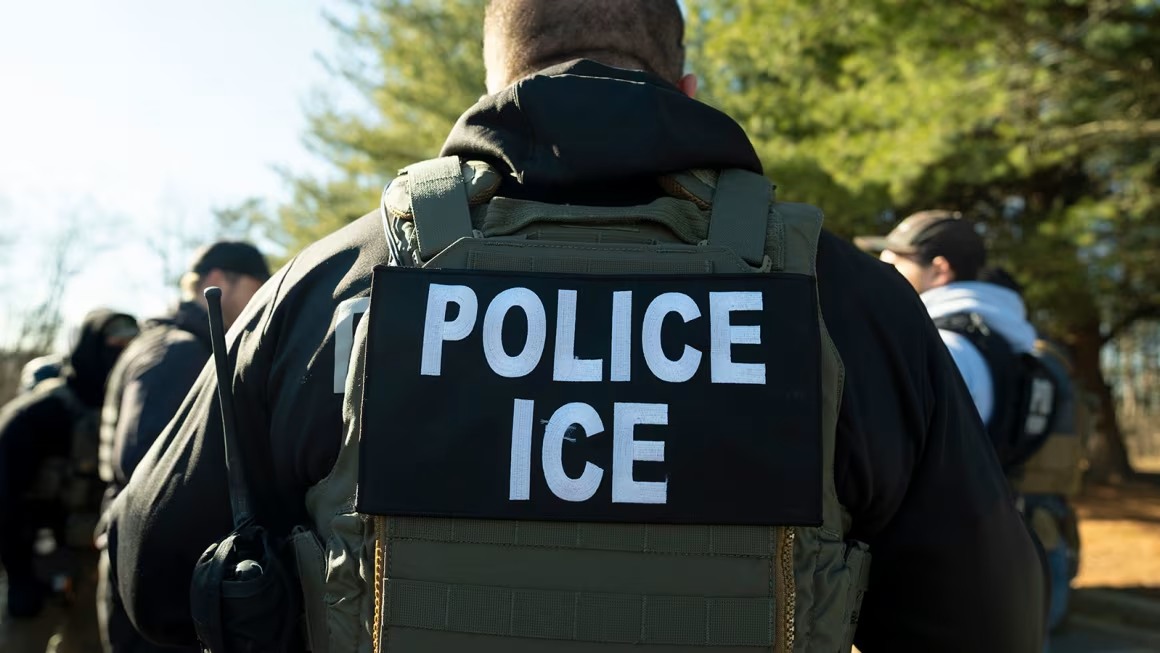
The progression of violent encounters involving Immigration and Customs Enforcement (ICE) agents has drawn a significant amount of attention across the United States, raising concerns about ICE’s authority and its role within law enforcement. While ICE is legally permitted to enforce federal immigration law, its expanding use of aggressive tactics raises concerns about its abuse of power. ICE has increasingly operated in ways that resemble everyday policing, blurring the line between immigration enforcement and policing. This ambiguity and extreme force tactics create a serious concern for civilian safety.
ICE’s Murky Legal Authority
ICE was created to enforce federal immigration law with the goal of preserving national security and public safety [1]. Unlike local police officers, ICE agents aren’t tasked with enforcing traffic laws or maintaining community safety. Yet, ICE agents have increasingly engaged in such practices that are similar to traditional policing, including vehicle stops [2]. Many reports have shown that agents have conducted vehicle stops where they don’t have a clearly identified target and are instead relying on police-style enforcement tactics such as running license plates [3]. Unlike targeted operations aimed at specific individuals that they know are violating immigration law, these traffic stops mirror everyday policing practices.
Public confusion surrounding ICE’s actions and authority reflects this ambiguity. Throughout social media platforms, such as Reddit, many users claim that ICE doesn’t have legal authority to conduct traffic stops and can only handle immigration issues, claiming that ICE officials should defer to state or local police [4]. While this statement is inaccurate, it highlights how unclear ICE’s role is to the general public. ICE agents may pull over and detain individuals based on reasonable suspicion that immigration law has been violated, but what constitutes reasonable suspicion is often vague and subjective [5]. In Terry v. Ohio, the Supreme Court ruled that officers can stop a suspect if they have “reasonable suspicion that the person has committed, is committing, or is about to commit a crime” [6]. Since this ruling relies on judgment rather than a set of criteria, many argue it leaves significant room for subjective enforcement. Reasonable suspicion can be ignited based on factors such as a person’s appearance, language, accent, and workplace [7]. Recent cases, such as that of Ramon Menera, which show how US citizens have been detained due to their accent, highlight how easily enforcement can slip into racial or ethnic profiling [8]. When immigration enforcement relies on subjective factors to determine reasonable suspicion, it puts all ethnic and naturalized US citizens at risk. While ICE’s actions may resemble policing, they have unclear guidelines and fewer safeguards than are typically required in policing. As a result, nearly anyone can be vulnerable to immigration enforcement interactions, not only in detentions but also in stops and other altercations. Although these guidelines allow for broad discretion, even ICE’s own rules are inconsistently applied during its operations.
The Blurring of ICE and U.S. Customs and Border Protection (CBP)
Lack of clarity within immigration enforcement is further shown with the overlapping roles of ICE and US Customs and Border Protection (CBP), which are both part of the Department of Homeland Security. ICE primarily enforces immigration laws within the US, and CBP manages border security [9]. This differentiation has become cloudier as Border Patrol agents have been assisting ICE with raids and the Trump administration has deployed CBP agents to ongoing protests in Minneapolis [9]. The consequences of this overlap have become prevalent with the killing of Alex Pretti, a US citizen who was shot by border patrol and CBP officers while recording the federal agents [10, 11]. This case shows how unclear enforcement roles can make it difficult to determine which agency should be held accountable when civilians are harmed. The recent blurring of agencies is largely due to the Trump administration’s priority to increase immigration enforcement. Trump’s executive order on his first day in office showed a huge priority shift towards immigration enforcement, placing increased pressure on ICE to raise arrest rates, with arrests averaging roughly 800 per day [12]. As immigration enforcement rapidly expanded under the Trump administration to meet these goals, the roles of ICE and CBP have increasingly overlapped, with many unclear guidelines.
ICE is Fundamentally Different from Local Policing
Police officers and ICE agents differ significantly in training, oversight, and accountability. While there are only eight state-wide mandates for body cams on police, body cams for police are increasingly common at the state and local level [13]. In contrast, federal immigration enforcement has historically operated without them and only recently started these transparency measures. In late January, Kristi Noem, the US Secretary of Homeland Security, started implementing body cams for federal agents in Minneapolis, highlighting how limited in scope these recent guidelines for transparency are in agencies like ICE [14]. Although Noem plans to expand body cams to all immigration agents in the future, body cameras remain uncommon in federal immigration enforcement. The limited use of body cams leaves no reliable way to know what federal officers do, creating clear gaps in public accountability. Advocates against body cams on federal agents claim they may be a tool to identify and track protesters, potentially violating privacy and their First Amendment rights [15]. However, the absence of consistent recordings raises a more serious concern. When enforcement actions are unrecorded, narratives can be shaped by federal agencies, limiting the public’s ability to know whether force is justified or excessive.
Additionally, ICE agents are frequently seen wearing masks and are not always required to identify themselves during encounters. While police officers are generally required to identify themselves, masked federal agents can make many civilians feel unsafe, with some individuals describing encounters as resembling kidnappings rather than lawful detentions. However, the official ICE website claims the masks are used to “prevent doxing, which can (and has) placed them and their families at risk,” [16]. This practice further distances federal officers from the same transparency and accountability that is often seen with local police.
Training standards further distinguish ICE from local law enforcement. Police officers go through extensive training, with the basic training academy having a minimum of 664 hours, not including hundreds of hours of in-field training [17]. In comparison, the ICE Academy training has been reduced from 22 weeks to seven weeks (or 47 days, a number supposedly chosen because of Trump being the 47th president), with the previous five weeks of Spanish language training being removed [18]. Although the Department of Homeland Security claims that “their training does not end when recruits graduate from the academy,” as they go through on-the-job training that is monitored closely and apply what they learned to real-life scenarios, these reduced requirements raise concerns about preparedness [19]. Their hiring practices have also shifted after the Trump administration, changing its age limit from 21 to 18, as well as student loan forgiveness and $50,000 bonuses, allowing for the expansion of federal agents [20]. Despite receiving less preparation, ICE agents are repeatedly put in high-risk police-like situations that demand great judgment. Placing ICE agents in these situations with reduced training not only increases risks for civilians but also for the agents themselves, who are put in scenarios where they are not adequately trained. It is clear that policing and federal agents have vastly different standards.
Accountability Mechanisms
Local police departments are subject to civilian review boards, state oversight, and more, allowing for increased accountability, transparency, and public trust [21]. ICE operates within federal systems that limit the same local accountability, allowing them to use significant force without the same checks. Raquel Adana, a professor in the UC Davis School of Law, says that “The whole system has been constructed to be as unchecked as possible,” demonstrating that there are not as many mechanisms put in place to protect citizens and hold ICE agents accountable for their aggressive tactics [21]. Although the Trump administration has opened investigations into shootings such as that of Alex Pretti, past cases show that criminal charges and holding federal agents accountable are rare [22]. Additionally, the Trump Administration can and has used the FBI to take over investigations and prevent state and local authorities from accessing critical evidence with these investigations [22]. This obstruction further emphasizes a lack of accountability within these federal programs. Unlike individuals whose rights were violated by a state or local police department that can sue for money damages in court, victims of ICE or CBP misconduct don’t have that opportunity. Federal law does not provide the same relief to victims of ICE and CBP’s brutality because the Constitution doesn’t have a civil remedy for the violation of the Bill of Rights. This difference fundamentally alters the balance of power between federal agents and civilians, allowing enforcement to expand without any consequences. The Trump administration is well aware of these barriers to accountability for ICE and the CBP and is intentionally exploiting them to expand their mission in getting illegal immigrants out of the U.S [22].
Use of Force
The use of deadly force by ICE agents has been prominent over the last year. While immigration enforcement often requires these tactics in order to properly detain targeted individuals who are not US citizens, many argue that certain cases have used unjustified amounts of force toward innocent individuals [23]. Policing standards generally discourage using heavy violence unless it is needed to de-escalate a situation, yet the nation has encountered ICE agents firing, beating, and tasing civilians in arguably unjust circumstances.
This pattern is evident in the Renee Nicole Good shooting. Footage contradicts claims that Good attempted to run over the agent, instead showing that she was turning to leave while the agent approached the vehicle. Good did not display an aggressive demeanor that would suggest she wanted to run him over as she repeatedly said, “That's fine, dude. I'm not mad at you” [24]. According to a senior Department of Homeland Security official, ICE officers are trained to never approach a vehicle from the front, which the ICE agent did. They are also instructed not to shoot at a moving vehicle and use force if there is an immediate risk, as shooting will not stop it from moving in the direction of the officer [25]. This decision to fire, therefore, appears inconsistent with established enforcement guidelines. Additionally, general self-defense standards allow deadly force only when there is an immediate threat, which raises questions about whether multiple shots were necessary in Good’s shooting [26]. Good’s death raises clear concern that ICE enforcement practices may conflict with law-enforcement safety norms, as they often resort to shooting when they feel even slightly threatened.
This incident is not isolated. Data on immigration enforcement suggests a broader pattern of increased use of force in recent years. In the first months of the administration, there was a 400% rise in use-of-force incidents, including cases involving hospitalized individuals, bystanders, and deaths [27]. This dramatic increase suggests that the use of force in ICE encounters has become more severe and frequent within the past year. These incidents occur continuously with the expansion of ICE. The Trump administration has clearly heightened these violent tendencies, as the Big Beautiful Bill has nearly doubled the number of officers and ICE agents from 10,000 to 22,000 [28]. It’s clear that while many think of ICE’s actions as a means of self-defense and a way to carry out their tasks, their lack of judgment, potentially stemming from reduced training protocols, often leads to fatal encounters.
Public Safety
ICE’s aggressive enforcement tactics raise serious concerns about civilian safety. There must be more safety nets in place that allow for open transparency and accountability among ICE agents in order to make our nation safe. Clear identification is a crucial first step. ICE agents should be required to visibly identify themselves so civilians can distinguish enforcement actions more clearly. Similar to police officers who are required to display their badge numbers, ICE agents could use badge numbers rather than full names. Doing so would allow for clarity on the civilian end without exposing agents to personal safety risks such as doxxing. Similarly, all federal agents should wear body cameras at a national level, allowing for their actions to be documented. This measure protects civilians and officers from untrue accusations, lowering the possibility of false narratives.
Although the ICE website has data regarding arrests, detentions, and removals, its website has not been updated since December 2024 and lacks sufficient detail [29]. It is important not only to have detailed reports but to make them readily accessible to the public, providing transparency. Without meaningful transparency and accountability, ICE’s expansion risks normalizing the use of police-like power without the same level of safeguards, which will ultimately be detrimental to civilian safety.
Sources
Picture:
Catherine E Shoichet. “What Is ICE and How Are Its Priorities Changing?” CNN. January 30, 2025. https://www.cnn.com/2025/01/30/us/ice-immigration-customs-enforcement-explained-cec.
[1] “U.S. Immigration and Customs Enforcement (ICE),” U.S. Immigration and Customs Enforcement, March 7, 2025, https://www.ice.gov/mission.
[2] “DHS Law Enforcement Experienced More than 180 Vehicle Attacks since President Trump Took Office,” U.S. Department of Homeland Security, February 3, 2026, https://www.dhs.gov/news/2026/02/03/dhs-law-enforcement-experienced-more-180-vehicle-attacks-president-trump-took.
[3] “How ICE Went Rogue,” American Immigration Council, February 11, 2026,
https://www.americanimmigrationcouncil.org/fact-sheet/ice-cbp-legal-analysis/#:~:text=Under%20the%20second%20Trump%20administration%2C%20immigration%20agents%20have%20a%20mandate,law%20says%20they%20are%20not.
[4] “Reddit - the Heart of the Internet,” Reddit.com, 2018, https://www.reddit.com/r/TrueUnpopularOpinion/comments/1qau3kv/ice_did_not_have_the_legal_authority_to_conduct/.
[5] Haley Fuller, “What Federal Immigration Enforcement Can and Cannot Do,” Military.com, January 17, 2026, https://www.military.com/feature/2026/01/15/what-federal-immigration-enforcement-can-and-cannot-do.html.
[6] Justia, “Terry v. Ohio, 392 U.S. 1” June 10, 1968,
https://supreme.justia.com/cases/federal/us/392/1/
[7] “Kristi Noem, Secretary, Department of Homeland Security, et al. v. Pedro Vasquez Perdomo,” Supreme Court of the United States, September 8, 2025,
https://www.supremecourt.gov/opinions/24pdf/25a169_5h25.pdf
[8] CNN Newsource Staff, “Border Patrol agent detains US citizen, tells him it’s ‘because of your accent’,” Fox 12 Oregon, January 18, 2026, https://www.kptv.com/2026/01/18/border-patrol-agent-detains-us-citizen-tells-him-its-because-your-accent/.
[9] Paige Cornwell, “ICE and Border Patrol: What is the difference?” The Seattle Times, January 24, 2026.,https://www.seattletimes.com/seattle-news/ice-and-border-patrol-what-is-the-difference/.
[10] Cara Tabachnick and Camilo Montoya-Galvez, “Agents were pursuing an immigrant when they killed Alex Pretti. Now, he shares his story,” CBS News, January 31, 2026, https://www.cbsnews.com/news/jose-huerta-chuma-alex-pretti-minneapolis-shooting/.
[11] Bora Erden, et al. “Timeline: A Moment-by-Moment Look at the Shooting of Alex Pretti,” The New York Times, January 25, 2026, https://www.nytimes.com/interactive/2026/01/24/us/minneapolis-shooting-alex-pretti-timeline.html.
[12] Catherine E. Shoichet, “What Is ICE and how are its priorities changing?” CNN, January 30, 2025, https://www.cnn.com/2025/01/30/us/ice-immigration-customs-enforcement-explained-cec.
[13] NCSL Staff, “Body-Worn Camera Laws Database,” National Conference of State Legislature, April 30, 2021,
https://www.ncsl.org/civil-and-criminal-justice/body-worn-camera-laws-database.
[14] Robert Tait, “Kristi Noem says all federal agents will begin wearing body cameras on patrols,” The Guardian, February 2, 2026, https://www.theguardian.com/us-news/2026/feb/02/ice-agents-body-cameras-senator-ron-johnson.
[15] Alfred Ng and Katherine Long, “ICE surveillance concerns shift Democrats’ demands for body cameras,” Politico, February 7, 2026, https://www.politico.com/news/2026/02/07/democrats-fear-body-cameras-could-be-ices-new-mass-surveillance-tool-00769363.
[16] “Immigration Enforcement Frequently Asked Questions,” U.S. Immigration and Customs Enforcement, August 28, 2025, https://www.ice.gov/immigration-enforcement-frequently-asked-questions.
[17] California Commission on Peace Officer Standards and Training, “Peace Officer Candidate Selection Standards,” State of California, 2024,
https://post.ca.gov/peace-officer-candidate-selection-standards.
[18] Rashawn Ray and Gabriel R. Sanchez, “ICE expansion has outpaced accountability. What are the remedies?” Brookings, January 26, 2026, https://www.brookings.edu/articles/ice-expansion-has-outpaced-accountability-what-are-the-remedies/.
[19] “Since Day 1, Secretary Noem, President Trump Have Enhanced Federal Law Enforcement Training, Equipped ICE to Keep the Public Safe and Arrest the Worst of the Worst,” U.S. Department of Homeland Security, January 22, 2026, https://www.dhs.gov/news/2026/01/22/day-1-secretary-noem-president-trump-have-enhanced-federal-law-enforcement-training.
[20] Zina Hutton, “Do Civilian Review Boards Work?” Governing, August 29, 2024, https://www.governing.com/workforce/do-civilian-review-boards-work.
[21] Alex Russel, “How Federal Immigration Enforcement Violence in Minneapolis Echoes U.S. History,” UC Davis Letters and Science Magazine, February 9, 2026, https://lettersandsciencemag.ucdavis.edu/government-violence-minneapolis-us-history.
[22] Brian Kolp, “What Power Do Ordinary Citizens Have to Keep Federal Agents Accountable?” Chicago Tribune, February 4, 2026, https://www.chicagotribune.com/2026/02/04/opinion-federal-agents-immigration-raids-accountability/.
[23] “Performance-Based National Detention Standards,” U.S. Immigration and Customs Enforcement, 2016, https://www.ice.gov/doclib/detention-standards/2011/pbnds2011r2016.pdf.
[24] Robin Stein, et al. “Video Analysis of ICE Shooting Sheds Light on Contested Moments,” The New York Times, January 16, 2026, https://www.nytimes.com/2026/01/15/video/ice-shooting-renee-good-minneapolis-videos.html.
[26] Shepard Law, “Self Defense & When This Applies to Criminal Cases,” February 2, 2025,
https://www.panamacityattorney.com/blog/2025/february/self-defense-when-this-applies-to-criminal-cases/#:~:text=Elements%20of%20a%20Self%2DDefense%20Claim&text=One%20of%20the%20most%20critical,in%20a%20self%2Ddefense%20situation.
[25] NBC News Staff, “Immigration agent fatally shoots driver in Minneapolis,” NBC News, January 8, 2026, https://www.nbcnews.com/news/us-news/live-blog/minnesota-ice-shooting-live-updates-rcna252852.
[27] “Report: ‘ICE Officials Knew Use of Force Was Rising Well Before Minneapolis Shootings,’” American Oversight, February 17, 2026,
https://americanoversight.org/report-ice-officials-knew-use-of-force-was-rising-well-before-minneapolis-shootings/.
[28] “ICE Announces Historic 120% Manpower Increase, Thanks to Recruitment Campaign That Brought in 12,000 Officers and Agents.” U.S. Department of Homeland Security,
January 3, 2026, https://www.dhs.gov/news/2026/01/03/ice-announces-historic-120-manpower-increase-thanks-recruitment-campaign-brought.
[29] “ICE Enforcement and Removal Operations Statistics,” U.S. Immigration and Customs Enforcement, 2024, https://www.ice.gov/statistics.