Temporary Status, Permanent Fear: How Executive Order 14188 Turned Visas into Tools of Intimidation
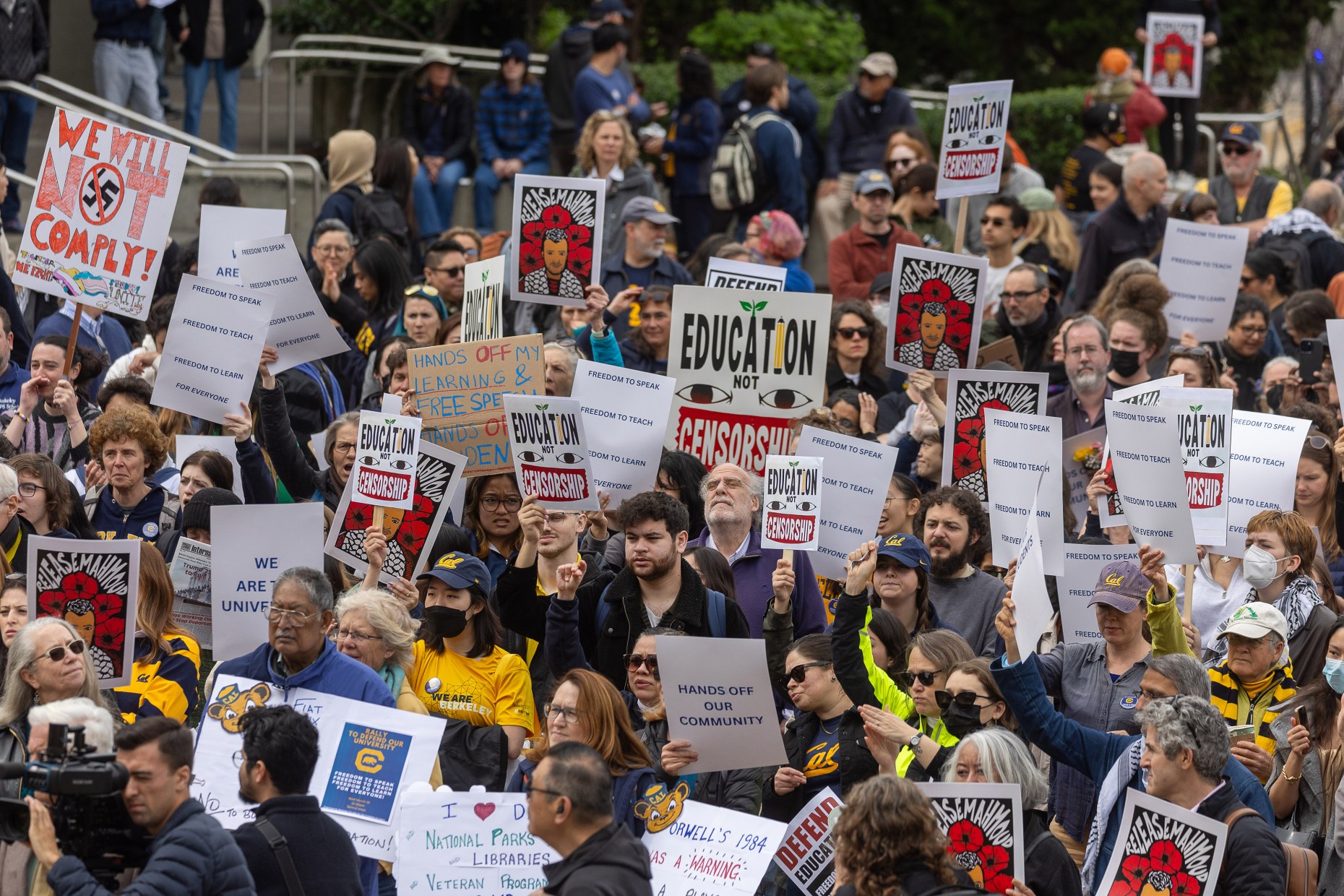
Students and faculty gather at UC Berkeley on March 19, 2025, to voice their opposition to the Trump administration. Photo by Karl Mondon from the Bay Area News Group.
They arrived with dreams neatly packed into their suitcases—aspiring Nobel laureates, future tech innovators, and emerging climate scientists. Yet, for many international students at universities across the United States, those dreams were unexpectedly disrupted by an email, a revoked visa, and, in some cases, detainment.
The Implementation of Executive Order 14188
This wave of disruptions began in early 2025, following President Donald Trump's signing of Executive Order 14188. The directive expanded the criteria for visa reviews and specifically targeted students engaged in political activism, with heightened scrutiny on pro-Palestinian advocacy [1]. This unprecedented move heightened attention toward international students, especially those who expressed dissent against U.S. foreign policy. Once known as sanctuaries for academic freedom and political expression, universities have been transformed into environments where political participation has resulted in the revocation of over 1,800 student visas [2]. U.S.-based scholars, including those international academics directly affected by the order and their domestic colleagues, widely viewed the action as a deliberate effort to suppress political activity by leveraging the power of immigration status.
In the United States, international students typically hold F, J, or M visas that are tracked through the Student and Exchange Visitor Information System (SEVIS) program [3]. This government database is designed to monitor the status and compliance of foreign individuals studying in the United States. Once granted a visa, students must remain enrolled full-time and comply with strict conditions, including refraining from activities that could violate U.S. laws [4]. Political participation, especially when it disrupts public order or criticizes U.S. foreign policy, has increasingly become grounds for visa revocation. This shift demonstrates how Executive Order 14188 responded directly to the growing political movements on U.S. campuses, particularly the rise of pro-Palestinian protests [5]. The order broadened the scope of visa reviews by allowing authorities to target students involved in demonstrations or dissent perceived as challenging the Trump administration’s interpretation of U.S. interests.
Under the new directive, the U.S. government embraced the catch-and-revoke strategy: an enforcement method designed to identify and cancel visas based on perceived SEVIS violations or participation in politically sensitive activities, often without formal criminal charges [6]. This approach relies heavily on social media monitoring, SEVIS data, and artificial intelligence to track students involved in politically charged actions [7]. As this procedure gained momentum, Secretary of State Marco Rubio vocally supported it by asserting that the U.S. had revoked hundreds of student visas as part of President Trump's efforts to suppress Palestinian protests on university campuses. During a visit to Guyana, Rubio remarked, “We do it every day, every time I find one of these lunatics” [8]. His statements underscored the administration’s stance by declaring that “if you apply for a student visa to come to the United States, and you say you're coming not just to study, but to participate in movements that vandalize universities, harass students, take over buildings, and cause chaos, we're not giving you that visa” [9].
Visa revocations linked to student activism have introduced a new tension into university life—one that makes immigration status and political expression inseparable. What happens when a visa transcends its role as a legal document, becoming a tool to stifle dissent? As seen in the unfolding crackdown on political activism, the answer became evident when President Trump signed Executive Order 14188—a directive that weaponized the threat of deportation to intimidate international students engaged in political actions, especially those advocating for Palestinian rights. Though many students whose visas were revoked ultimately returned to campus, the order’s lingering implications raise essential questions about due process, ideological discrimination, and the extent to which universities can protect their students under federal pressure [10].
Impact on International Students across the U.S.
The impact of Executive Order 14188 entered the public consciousness with the detainment of Mahmoud Khalil, a Syrian graduate student at Columbia University. Khalil, known for his leadership in pro-Palestinian demonstrations, was suddenly arrested by federal authorities on March 8, 2025 [11]. He was accused of involvement with Hamas, a designated terrorist organization, and his visa was subsequently revoked with no prior warning [12]. The revocation abruptly halted years of research and academic progress by imposing an emotional and financial burden on Khalil that forced him to abandon his studies and return to his home country. Many other international scholars whose academic careers and personal lives were destabilized by the unanticipated consequences of their political expression had experiences mirroring Khalil’s [13]. His story sparked outrage among university students and emerged as a central talking point in the growing debate surrounding the revocation of international scholars’ visas.
As the effects of Executive Order 14188 spread, the academic community began to voice its collective concern. At Stanford University, for example, students and faculty responded to visa revocations with an outpouring of solidarity. Liam Sherman, a second-year PhD student in physics, noted that the Stanford Graduate Workers Union—which represents a large number of international students—witnessed a significant surge in support as the revocations gained momentum. Sherman explained that “it’s mobilized a lot of people because they see that it’s this random, chaotic, stressful, fear-inducing thing that is happening to their colleagues” [14]. This response highlights a growing sense of unease among directly affected students and those in solidarity with them, who fear that their futures could be jeopardized at any moment. The expansiveness of visa cancellations sparked a collective frustration and helplessness that rippled through the academic landscape by exposing the international scholars’ vulnerability in an environment growing increasingly hostile to political speech.
Executive Order 14188 has increasingly impacted the University of California (UC) system, where students' academic lives have been disrupted by visa revocations and fears of losing legal status. At UCLA, six students were forced to leave their classes after facing the threat of deportation [15]. UC Davis reported two similar cases, while UC Riverside saw at least one student affected [16]. These cases of disruption reflect a broader trend. Anonymous students at UC Irvine and UC Santa Barbara describe a constant state of fear and uncertainty regarding if or when their visas might be revoked [17]. UC Santa Cruz reported that three of its students had their visas revoked “with no advance notice,” according to a university spokesperson. The only notification the students received about visa revocations came in the form of a brief email from the federal SEVIS platform, which offered no explanation beyond indicating the visa’s termination and advising students to “seek outside legal counsel” [18]. At UC San Diego, the directive’s consequences were even more widespread: five international students had their F-1 visas suddenly terminated, and a sixth was detained at the border, denied entry, and deported without prior warning [19]. NBC 7 captured the emotional toll on the affected UCSD students by describing them as “devastated” and “confused” as to why their legal status was abruptly terminated [20]. Six UC Berkeley students’ visas were also revoked without notice, which has impeded their academic progress and long-term career aspirations [21]. Triny, an undergraduate student at Berkeley, voiced the growing concerns shared among her international peers, stating, “It’s really scary. I think there’s a lot of fear in general. It’s very scary overall” [22]. Reflecting on her peers’ experiences, she remarked, “It’s sadly ironic that this has happened here. People have been silenced for speaking out, literally sent back to where they are from for expressing their rights.” This stark reality highlights not only how visa revocations negatively impact students' academic trajectories, but also the emotional and legal turmoil that these sudden actions impose on affected individuals.
The U.S. Government’s Use of Visas as a Threat
Executive Order 14188 represents a significant shift in the U.S. government's interactions with international students, particularly in how visas are utilized in the context of political activity. The directive’s implementation establishes a concerning precedent that intertwines immigration laws with political discourse. Initially directed at pro-Palestinian activism, the order’s impact extends far beyond this specific issue and sparks concerns about the U.S. government’s role in shaping political expression through visa policies.
One immediate consequence of Executive Order 14188 is U.S. universities’ loss of intellectual liberty, which fuels instability for international students. The directive undermines the foundation of academic freedom by making international students' educational journeys contingent on their political views. Kevin Johnson, an immigration law professor at UC Davis, highlights the order’s broader effects, pointing out their significant academic and financial consequences for universities [23]. Fifty thousand UC and California State University students are from outside the United States, making international students integral to these institutions' financial sustainability and academic vitality [24]. Johnson warns that politically motivated visa revocations could discourage international students from attending colleges in the United States and lead to long-term economic repercussions and a decline in the diversity of thought and research. As he explains, “It’s going to have an impact on students coming, impact on universities in paying revenues, and that means there’s likely to be fewer foreign scholars who decide to come to the U.S. or stay after they’ve gotten a degree here” [25]. Furthermore, families who invest substantial financial and emotional resources in sending their children to study in the United States are now left questioning whether the country can still be relied upon as a stable and safe destination for higher education. As Bernie Burrola, Vice President at the Association of Public and Land Grant Universities, notes, “Students spend quite a bit of money when they come to university. Do they want to invest that time and money, and then get a visa termination? I’m sure that calculus is happening around the world right now, with students weighing their options between a U.S. higher education and that of another country” [26]. This growing uncertainty weakens the U.S. higher education system’s credibility by making students wonder whether the risks of studying in the United States outweigh the potential rewards.
Beyond surrounding U.S. higher education with uncertainty for international students and restricting academic freedom, Executive Order 14188 presents a profound challenge to the rights of all Americans by using immigration status as a means of limiting political participation in U.S. foreign affairs. The government's ability to revoke visas without explanation or prior notice creates a climate of fear and instability that effectively silences dissent and discourages open criticism of U.S. policies. This tactic disrupts individual academic and professional futures while doubling as a form of political intimidation. Additionally, as Bill Hing, a UC San Francisco immigration law professor, explains, “Even after revocation, students are often still legally present in the U.S. and entitled to due process and institutional protection” [27]. The lack of recognition for international students’ rights creates a chilling effect that threatens not only international students, but also U.S.-born individuals whose rights could similarly be violated under the guise of limiting foreign affairs dissent. When governmental power is applied so broadly and ambiguously, it risks eroding fundamental freedoms that protect everyone within the academic community and beyond. Executive Order 14188 exemplifies this threat because it threatens First Amendment rights and sets a dangerous precedent for expanding these attacks into other contexts. In response to these dangers, Aradhna Tripati—a UCLA professor and member of the Council of UC Faculty Associations—stresses the importance of “stand[ing] firmly in defense of our constitutional rights” [28]. Pro-international-student advocates like Tripati argue that universities cannot remain silent in the face of politically motivated visa revocations. Such silence ultimately undermines the rights of all Americans—citizens and non-citizens alike.
Executive Order 14188 has added a new layer to the international student experience, one in which immigration policy and academic life intersect in subtle but significant ways. While its full impact is still unfolding, the order highlights how education, policy, and political expression are increasingly intertwined. For many, the college campus is no longer just a space for lectures and research; it has become a place where students’ academic ambitions are weighed against the federal government’s growing interest in surveillance and control. As universities adapt, they face an urgent challenge: safeguarding the openness that drives scholarship while defending the constitutional rights, such as freedom of speech and due process, that should protect every student. Perhaps the real story here is about not just a new policy, but a shifting national narrative in which being a student in the United States comes with conditions that test the very ideals the country claims to uphold. If policies like Executive Order 14188 go unchallenged, they risk setting a dangerous precedent that grants student rights only when they are politically convenient.
Sources
[1] Dunbar, Marina. “US Government Has Revoked More Than 600 Student Visas, Data Shows.” The Guardian. April 10th, 2025. https://www.theguardian.com/us-news/2025/apr/10/how-many-student-visas-revoked.
[2] Dunbar, “US Government Revoked Visas.”
[3] “Student and Exchange Visitor Information System (SEVIS).” U.S. Immigration and Customs Enforcement. https://www.ice.gov/sevis.
[4] U.S. Immigration and Customs Enforcement. “SEVIS.”
[5] Dunbar, “US Government Revoked Visas.”
[6] Dunbar, “US Government Revoked Visas.”
[7] Dunbar, “US Government Revoked Visas.”
[8] Halpert, Madeline. “Marco Rubio Says US Revoked at Least 300 Foreign Students' Visas.” BBC. March 25th, 2025. https://www.bbc.com/news/articles/c75720q9d7lo.
[9] Halpert, “US Revoked Visas.”
[10] Tucker, Brianna. “Federal Judge Blocks Trump From Revoking International Students’ Immigration Status.” The Washington Post. May 22nd, 2025. https://www.washingtonpost.com/politics/2025/05/22/trump-foreign-student-visas-sevis/.
[11] Otis, Ginger A. “ICE Arrests Columbia Student Who Helped Lead Pro-Palestinian Protests.” The Wall Street Journal. March 9th, 2025. https://www.wsj.com/us-news/dhs-detains-columbia-student-who-helped-lead-pro-palestinian-protests-fbbd8196?mod=article_inline.
[12] Otis, “ICE Arrests Columbia Student.”
[13] Otis, “ICE Arrests Columbia Student.”
[14] Bauman, Anna. “Trump Administration Sows Panic at California Universities After Revoking Over 100 Student Visas.” San Francisco Chronicle. April 9th, 2025. https://www.sfchronicle.com/bayarea/article/trump-student-visas-california-universities-20265095.php.
[15] Symon, Evan. “45 California University Student Visas Revoked by Trump Administration.” California Globe. April 7th, 2025. https://californiaglobe.com/fr/45-california-university-student-visas-revoked-by-trump-administration/.
[16] Symon, “45 Student Visas Revoked.”
[17] Symon, “45 Student Visas Revoked.”
[18] Kaleem, Jaweed. “Caught Off-Guard, California Colleges Scramble to Determine Scope of Student Visa Cancellations.” Los Angeles Times. April 7th, 2025. https://www.latimes.com/california/story/2025-04-07/ucla-california-universities-concerns-cancellations-student-visas.
[19] NBC 7 Staff. “UC San Diego Says 5 Students Have F-1 Visas Revoked, 6th Student Deported.” NBC San Diego. April 14th, 2025. https://www.nbcsandiego.com/news/local/5-ucsd-students-have-f-1-visas-revoked-6th-student-deported/3796134/.
[20] NBC 7 Staff, “5 Students Have Visas Revoked.”
[21] Symon, “45 Student Visas Revoked.”
[22] Barnard, Cornell. “Visas Being Revoked for UC Berkeley, Stanford International Students With Ties to Political Activism.” ABC7 News. April 7th, 2025. https://abc7news.com/post/dept-homeland-security-revokes-visas-uc-berkeley-stanford-international-students-tied-past-activism/16136682/.
[23] Bauman, “Trump Administration Sows Panic.”
[24] Burke, Michael. “Updated: Trump Administration Revokes Visas for 19 UC Berkeley Students and Recent Graduates.” Berkeleyside. April 8th, 2025. https://www.berkeleyside.org/2025/04/08/trump-administration-student-visas-revoked.
[25] Bauman, “Trump Administration Sows Panic.”
[26] Burke, “Trump Administration Revokes Visas.”
[27] Bauman, “Trump Administration Sows Panic.”
[28] Veerabahu, Prannay. “UCLA Faculty Association Rallies to Demand University Response to Visa Revocations.” Daily Bruin. April 13th, 2025. https://dailybruin.com/2025/04/13/ucla-faculty-association-rallies-to-demand-university-response-to-visa-revocations.