
India's Strategic Autonomy: A Moderating Force in the Rules-Based International Order
Since its inception, Indian foreign policy has had an independent streak, rooted in its experience under British colonialism and the principles of the first Indian Prime Minister, Jawaharlal Nehru. While Nehru found ideological common ground with the West on democratic principles and the Soviet Union on socialist ones, Nehru concluded that India needed to walk a “third way" to maintain sovereignty and avoid becoming a pawn of the two great powers by being trapped in a political bloc. In the words of Former Indian Minister of Defense V. K. Krishna Menon to the 1960 United Nations General Assembly (UNGA), “My country does not stand for the formation of blocs, because blocs mean isolation. We stand for a universal world" [1].
The foundational principle of avoiding committing itself to a greater power has remained ingrained in Indian foreign policy to the current day. However, in recent years, India has grounded the spirit of its foreign policy in multilateralism, in which countries with differing views come together to cooperate, make compromises where possible, and coordinate to find solutions [2]. Under the framework of multilateralism, India has leveraged its non-aligned status to build relationships with countries from a variety of political leanings, not only to advance its national interests, but to grow its influence on the global stage in international institutions as a leader of the Global South. In positioning itself as a leader of the Global South, India seeks to reform the rules-based international order to be more shaped by non-Western voices. Despite China's increasing economic dominance over the Global South and a transactional American foreign policy under Trump, India offers a democratic alternative to China for bridging the political interests of the Global South to the international sphere, weakening the potential polarization that could push these nations into the anti-Western camp.
India's Direct Efforts to Make Rules-Based International Order More Inclusive
India’s position is that the current structure of international organizations does not mirror the realities of today, with Indian Minister of Foreign Affairs S. Jaishankar stating last year that the “UN still reflects the realities of 1945, not 2025” [3]. Within the UN, India is a leading voice in the L.69 group, which is made up of developing countries calling for reform of the United Nations Security Council (UNSC) [4,5]. Furthermore, India, as one of the G4 nations since 2005, which also includes Brazil, Germany, and Japan, acts in support of these nations' respective bids for the permanent seats on the UNSC. However, these demands have not led to significant tangible reform of the United Nations [6].
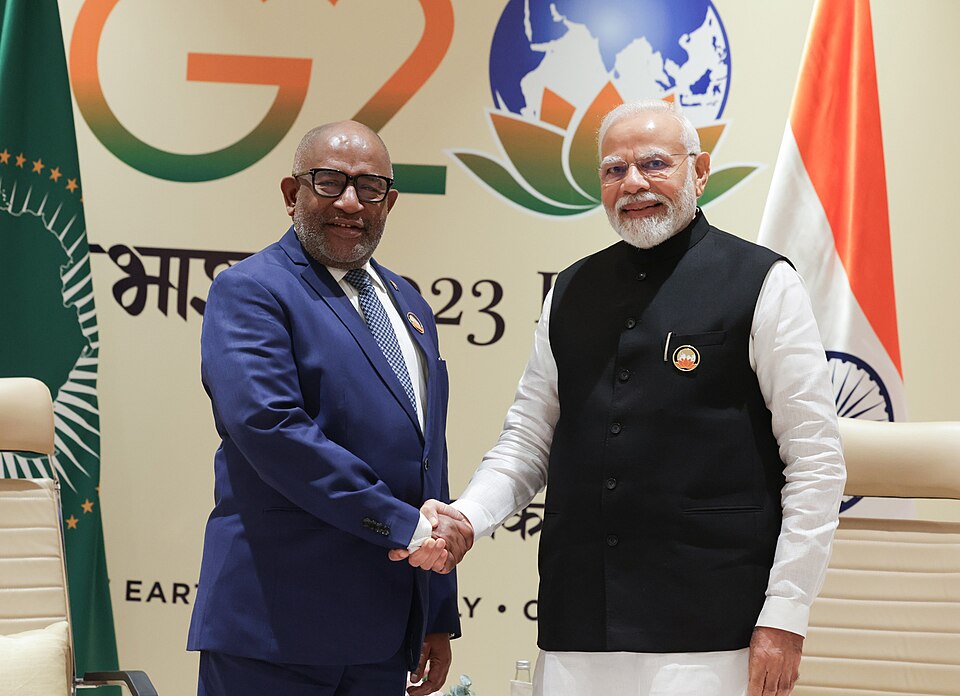
A prominent example of India expanding a traditionally Western-dominated organization was the G20's admission of the African Union during India's presidency in 2023. Prime Minister Narendra Modi wrote to the leaders of G20 member states proposing the admission of African Union states as members to the G20 [7,8]. The African Union's admission demonstrated that India values their voice in high-level decision-making, strengthening the coalition between African Union nations and India in advancing the interests of the Global South. Moreover, before the 2023 G20 New Delhi Summit, India held its first virtual "Voice of the Global South” summit including 125 different developing nations across the globe, in which it provided a common platform to deliberate on the issues and concerns of the Global South, but also to channel these inputs into a mandate for India to take action on behalf of the Global South at the G20 summit. Within three months after the summit, India held a second “Voice of the Global South” summit, which provided a platform for India to discuss with other Global South nations ways to continue working toward making the international rule-based world order more inclusive, representative, and progressive [9]. India committed itself to continued collaboration with partners in the Global South during the first “Voice of the Global South” summit, with Modi inaugurating “DAKSHIN - Global South Center of Excellence,” a collaborative initiative that strives to push towards achieving the UN’s Agenda 2030 and localizing its sustainable development goals (SDGs).
India's Investment in the Global South
The symbolism of India bringing together the developing world and building an ecosystem for continued collaboration is strong, but also, more concrete measures were taken to empower Global South economies as a key part of India's push for inclusivity in the international rule-based world order. India secured a consensus at the G20 Digital Economy Ministers meeting, collaborating with the United Nations Development Programme (UNDP) and the World Bank to define Digital Public Infrastructure (DPI) and its management for SDG progress [11]. DPI, in simple terms, consists of a national digital identification, an integrated universal system of payment that allows money to move between people and businesses regardless of their bank, and allows different systems, such as a medical office and an insurance carrier, to share information securely with an individual’s permission, all while keeping the technical specifications public [12,13]. Hence, India aims to provide developing nations with a blueprint for developing sovereign digital economies without relying on Western proprietary systems or Chinese-surveilled software. India is pushing for a tripling of annual lending levels by Multilateral Development Banks (MDBs), such as the World Bank and regional development banks like the African Development Bank, by 2030, so developing countries can get loans approved at a faster rate. Through these measures, India demonstrates to the Global South that it is not only interested in increasing their collective political power, but is invested in their economic growth [14].
India's Role in QUAD and BRICS
Concerning India's role in diplomatic blocs, India's involvement in the Quadrilateral Security Dialogue (QUAD) and BRICS appears at first to be hypocritical on the part of India, but the nature of its involvement in both demonstrates India's consistent position as a reformist player in the rules-based international order. For India, BRICS is an organization that provides it with a platform to lay out a vision for greater economic cooperation with non-Western nations. Notably, Russian President Vladimir Putin quoted Modi at the 2024 BRICS Summit, stating, “BRICS is not an anti-Western group, it's just a non-Western group” [15]. While the degree to which BRICS as an organization is anti-Western is debatable, especially since each founding member state has differing relationships with the West, India refused to go beyond economic cooperation in BRICS, as it was the only founding member to not participate in BRICS's joint naval drills in January 2026 in South Africa, where Brazil participated only as an observer [16].
Concerning the QUAD, India has taken action to maintain international maritime law in the Indo-Pacific, but it is not a security alliance, with India's reluctance being a key reason [17]. Through the QUAD, India seeks to cooperate with the United States, Japan, and Australia on maritime security in the Indo-Pacific. While the QUAD is often described as an anti-China alliance, it is more structured to enable diplomatic cooperation and security dialogues to find solutions to issues such as breaches of fishing regulations, threats to freedom of navigation, and safeguarding against militarization. While militarization and threats to freedom of navigation are often deemed in the South China Sea to come from China, China is not often singled out as a perpetrator by the QUAD, and being a member affirms India’s commitment to international maritime law, and by extension, the rules-based international order [18].
Current Challenges
China has a much stronger economic influence in the Global South, globally, and with India's neighbors than India does. India made a total financial commitment of $350 million USD to its neighboring countries of Afghanistan, Bangladesh, Myanmar, Nepal, Pakistan, and Sri Lanka in 2022, while China made a total financial commitment of $2.32 billion USD [19]. In part, China is able to capitalize on anti-India sentiments in these nations stemming from concerns over Indian paternalism, combined with the perception that Chinese investment through the Belt and Road Initiative comes with fewer strings attached [20].
However, India's influence on the rules-based international order is that it challenges the idea that the rules are only meant for the Western powers, and provides them with an extra layer of legitimacy for other nations in the Global South. Nevertheless, the United States taking a more transactional approach to foreign policy has led to concern that there might not be any international law left to be enforced, with Trump stating, “I don't need international law” [21]. Moreover, Trump threatened India's strategic autonomy, claiming that India agreed to stop buying Russian oil in exchange for rolling back an additional 25% tariffs on India [22]. Despite beginning to cut back Russian crude oil purchases following this announcement from Trump, India has not made any moves to distance itself politically from Russia under pressure. This indicates that India has the intention not to bow to Western pressure, which could protect India's image as a nation that does not let intimidation prevent it from adhering to its principles.
Nevertheless, India previously bowed to American pressure in the past concerning oil purchases, particularly concerning Iran and Venezuela, which did result in a diplomatic chill between India and those nations [23]. India was Venezuela’s second-largest customer for oil exports, after the United States, since 2008. When the United States imposed sanctions on Venezuela’s oil sector in 2019, India briefly became Venezuela’s chief customer, before acquiescing under a short period of time to American pressure to halt Venezuelan oil imports [24,25]. Relations between India and Venezuela chilled between 2019 and 2025, but coinciding with American pressure to shift oil imports from Russia to Venezuela, India changed its tone on Venezuela, voicing interest in deepening cooperation [26]. Despite Iran supplying officially over 10 percent of India’s oil imports in the late 2010s, by 2019, India complied with United States sanctions to cease oil imports from Iran [27]. Moreover, India heightened its pressure on Iran recently, not allocating funding for the Chabahar port in Iran in its 2026 Union Budget, previously viewed as a key project to enable trade and outreach to Afghanistan and Central Asia [28]. Nonetheless, it is too early to tell what the exact ramifications of Trump and India's trade war over purchasing Russian crude oil will be, but a situation that results in the end of India's strategic autonomy would prevent India from acting as a moderating force.
Over the past 76 years, India’s foreign policy has evolved from defensive non-alignment aimed at preventing domination by a superpower to a more assertive role in reforming the international order. India has made significant efforts, especially in other developing countries, to find areas of cooperation on the international stage in an attempt to reform the rules-based international order to be more inclusive of the interests of the Global South, but increasing tensions with the United States and China could prove to be a significant hurdle.
Sources
[1] Swapna Kona Nayudu, “The Non-Aligned Manifesto,” History Workshop, May 19, 2023. https://www.historyworkshop.org.uk/empire-decolonisation/the-non-aligned-manifesto/.
[2] “Multilateralism: What Is It and Why Does It Matter?,” UN News, February 18, 2025, https://news.un.org/en/story/2025/02/1160226.
[3] Kushal Deb, “‘UN Still Reflects the Realities of 1945, Not 2025’Jaishankar Calls for Urgent Reform,” WION, October 16, 2025,https://www.wionews.com/india-news/un-1945-realities-not-2025-jaishankar-urgent-reforms-1760615121946.
[4] Yoshitam Singh, “L.69 Group of Nations Commit to Instilling ‘New Life’ in Efforts towards Achieving UNSC Reform,” The Print, September 24, 2022, https://theprint.in/world/l-69-group-of-nations-commit-to-instilling-new-life-in-efforts-towards-achieving-unsc-reform/1140806/.
[5] “L.69 Model,” February 15, 2025,https://estatements.un.org/estatements/10.0010/20240215100000000/p0QKV84eCKXR/vwXSwpkcbnsD_en.pdf.
[6] Sérgio França Danese, “Joint G4 Statement by Brazil, Germany, India, and Japan at the Informal Meeting of the General Assembly on the Intergovernmental Negotiations on Security Council Reform,” June 20, 2024, https://estatements.un.org/estatements/10.0010/20240620100000000/aSFFne2CVcjS/VsWRFpxyeGgp_en.pdf.
[7] Rupam Jain, “India’s Modi Seeks African Union’s Full Membership in G20,” Reuters, June 18, 2023, https://www.reuters.com/world/indias-modi-seeks-african-unions-full-membership-g20-2023-06-18/#:~:text=By%20Reuters,countries%20and%20the%20European%20Union.
[8] Alex Vines, “The African Union Becomes a Full Member of the G20,” Wilson Center, January 28, 2025, https://www.wilsoncenter.org/article/african-union-becomes-full-member-g20.
[9] “Voice of Global South Summit 2023 | Ministry of External Affairs.” Accessed February 17, 2026. https://mea.gov.in/voice-of-global-summit.htm.
[10] “DAKSHIN,” Global South Centre of Excellence, accessed 30 March, 2026, https://dakshin.org.in/about-us.
[11]“G20 Digital Ministers Recognize Digital Public Infrastructure as an Accelerator of the Global Goals,” United Nations Development Programme, August 19, 2023, https://www.undp.org/press-releases/g20-digital-ministers-recognize-digital-public-infrastructure-accelerator-global-goals.
[12] United Nations Development Programme, “G20 Digital Ministers.”
[13] “India’s Digital Public Infrastructure Gains Traction in Global South,” Asian Banking and Finance, November 14, 2025, https://asianbankingandfinance.net/news/indias-digital-public-infrastructure-gains-traction-in-global-south.
[14] Karen Mathiasen, “Did India’s G20 Finance Ministerial Move the Needle on MDB Reform?” Center for Global Development, July 19, 2023, https://www.cgdev.org/blog/did-indias-g20-finance-ministerial-move-needle-mdb-reform#:~:text=The%20just%20released%20report%20co,for%20a%20new%20financing%20window.
[15] “‘Not Anti-Western but ...’: Putin Borrows PM Modi’s Words to Describe BRICS,” The Times of India, October 18, 2024, https://timesofindia.indiatimes.com/world/europe/not-anti-western-but-putin-borrows-pm-modis-words-to-describe-brics/articleshow/114356100.cms.
[16] Yashraj Sharma, “BRICS Wargames: Why They Matter, Why India Opted Out,” Al Jazeera, https://www.aljazeera.com/news/2026/1/11/brics-wargames-why-they-matter-why-india-opted-out.
[17] Aparna Pande, “India’s Evolving Role in the Quad,” Hudson Institute, February 5, 2026, https://www.hudson.org/security-alliances/indias-evolving-role-quad-aparna-pande.
[18] Zara Ali, “India’s Relationship With the Quad,” Georgetown Journal of International Affairs, May 1, 2023, https://gjia.georgetown.edu/2023/05/01/engagement-not-entanglement-indias-relationship-with-the-quad/.
[19] Vijaya Subrahmanyam, Penelope Prime, and Dr. Usha Nair Reichert, “India’s Outward Foreign Direct Investment in the Context of China’s Belt and Road Initiative,” China Research Center, August 24, 2024, https://www.chinacenter.net/2024/china-currents/23-1/indias-outward-foreign-direct-investment-in-the-context-of-chinas-belt-and-road-initiative/.
[20] Chilamkuri Raja Mohan, “India and South Asia: The Elusive Sphere of Influence, ” January 6, 2022,https://www.isas.nus.edu.sg/papers/india-and-south-asia-the-elusive-sphere-of-influence/.
[21] Maya Yang, “‘I Don’t Need International Law’: Trump Says Power Constrained Only by ‘My Own Morality,’” US News. The Guardian, January 8, 2026. https://www.theguardian.com/us-news/2026/jan/08/trump-power-international-law.
[22] “Got India’s Commitment to Stop Buying Russian Oil: US Secretary of State Rubio,” The Economic Times, February 15, 2026, https://economictimes.indiatimes.com/industry/energy/oil-gas/got-indias-commitment-to-stop-buying-russian-oil-us-secretary-of-state-rubio/articleshow/128386388.cms?from=mdr.
[23] “Joint Statement Following the 23rd India - Russia Annual Summit (December 05, 2025),” Ministry of External Affairs Government of India, https://mea.gov.in/bilateral-documents.htm?dtl/40410.
[24] Hari Seshasayee. “India-Venezuela Relations: A Case Study in Oil Diplomacy,” February 14, 2019, https://www.wilsoncenter.org/publication/india-venezuela-relations-case-study-oil-diplomacy.
[25] Lucia Kassai. “Venezuela Oil Crisis Deepens With India Refiners Halting Imports,” Bloomberg, June 26, 2020, https://www.bloomberg.com/news/articles/2020-06-25/venezuela-oil-crisis-deepens-with-india-refiners-halting-imports.
[26] “PM Receives a Telephone Call from the Acting President of Venezuela,” PMIndia, January 30, 2026, https://www.pmindia.gov.in/en/news_updates/pm-receives-a-telephone-call-from-the-acting-president-of-venezuela/.
[27] Agence France-Presse, “India Has Ended Iranian Oil Imports, Ambassador Says,” Voice of America, May 24, 2019, https://www.voanews.com/a/india-has-ended-iranian-oil-imports-ambassador-says/4931786.html.
[28] Vishnu Som, “No Funds For Chabahar Port Project In Union Budget Amid US-Iran Tensions,” NDTV, February 1, 2026, https://www.ndtv.com/india-news/union-budget-2026-live-no-funds-for-chabahar-port-project-in-union-budget-amid-us-iran-tensions-10925487.
[29] Divyesh Singh, “How Iran-Linked Oil Tanker Seized by India Went Dark after Entering Pak’s Sea Zone,” India Today, February 20, 2026, https://www.indiatoday.in/india/story/how-iran-linked-oil-tankers-seized-by-india-went-dark-after-entering-pakistans-sea-zone-2871376-2026-02-20.
Image: India Prime Minister’s Office, “Prime Minister Narendra Modi in a bilateral meeting with the Chairperson of the African Union and President of the Comoros, Mr. Azali Assoumani, in New Delhi,” Wikimedia Commons, September 10, 2023, https://commons.wikimedia.org/wiki/File:Prime_Minister_Narendra_Modi_in_a_bilateral_meeting_with_the_Chairperson_of_the_African_Union_and_President_of_the_Comoros,_Mr._Azali_Assoumani,_in_New_Delhi_on_September_10,_2023.jpg