
How the Republican Party became Anti-immigration
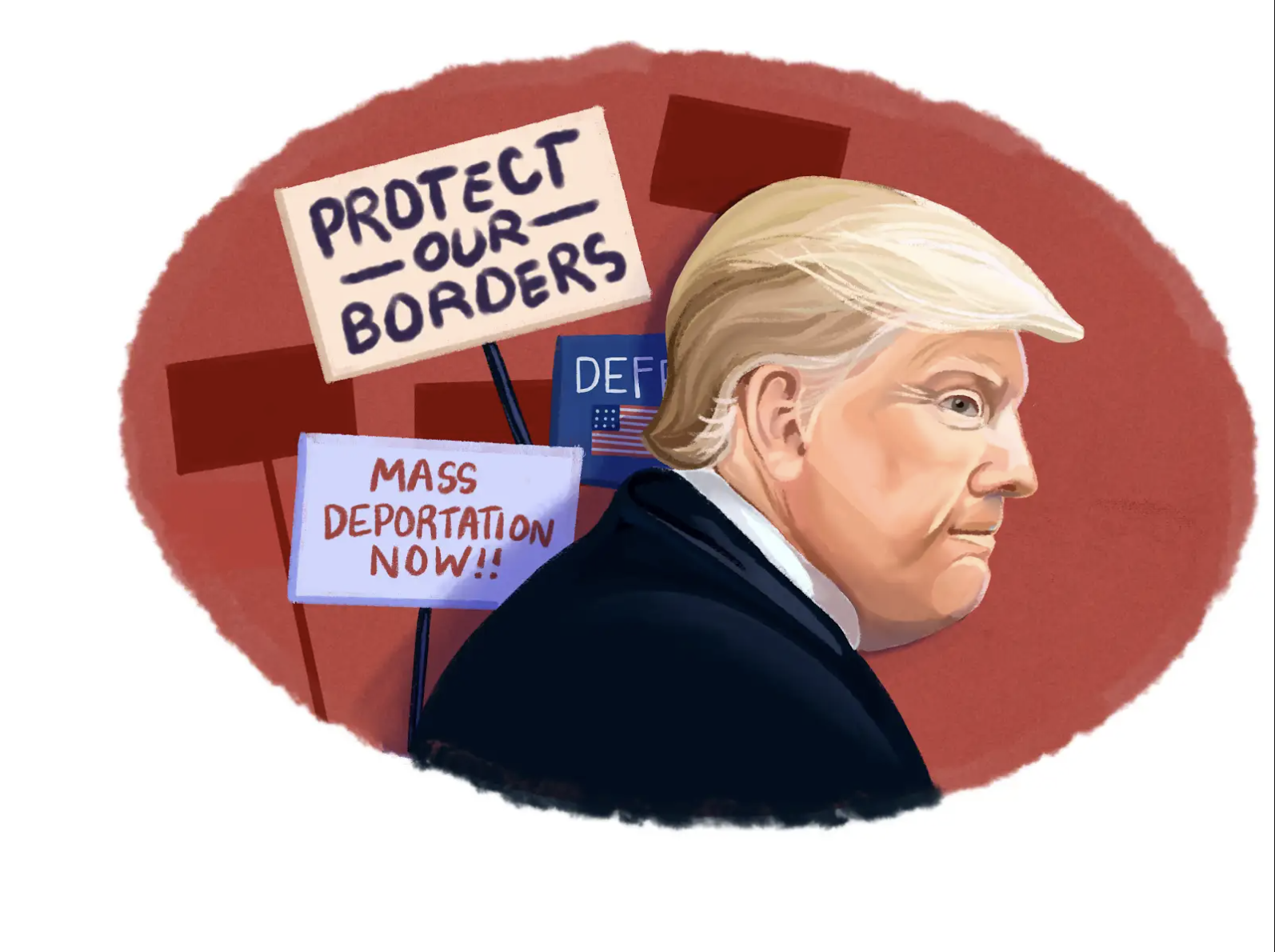
Today, immigration is one of the Republican Party’s strongest issues [1]. However, this was not always the case. Prior to 2016, the Republican Party wanted presidential candidates who were softer on documented and undocumented immigration, viewing immigrant labor as economically beneficial. It was the rise of the Tea Party in 2010 and the subsequent election of Donald Trump in 2016 that popularized anti-immigration rhetoric. Since then, Republicans have framed immigration as a cultural and economic threat, advocating for policies that aim to decrease the number of immigrants in America by heightening border security, increasing enforcement of immigration law and deportations, and ending benefits—like tax credits and Medicare—for undocumented immigrants.
Before Trump, Republican presidents typically embraced immigration. In 1986, Reagan signed the Immigration Reform and Control Act, granting legal status or amnesty to 3 million undocumented immigrants [2]. Four years later, George H.W. Bush signed the Immigration Act of 1990, allowing more immigrants to enter the U.S. to “cultivat[e] a more competitive economy” [3, 4]. George W. Bush proposed a temporary worker program that would give migrants legal status to work in the U.S. for a renewable three-year period, with the expectation that these migrants would return to their home countries once their work was finished [5]. These three presidents’ positions were all in line with that of the business wing of the GOP, which favored immigration for creating a larger pool of workers, filling labor shortages and making it easier for companies to find skilled workers. For a long time, the business lobby was able to successfully convince Republican politicians that immigration supported the American economy [6]. As a result, Republicans traditionally worked to enact policies that would allow more migrant workers to come to America. However, the business lobby’s influence over the issue started slipping once immigration became part of the populist right’s agenda.
The Tea Party and Trump
Following the Great Recession, the Tea Party emerged as a libertarian economic movement advocating for fiscal responsibility [7]. The Tea Party was quickly co-opted by the populist right, turning the movement into a bastion of social conservatism [8]. Members of the Tea Party started viewing immigration as both an economic and cultural threat [9]. For instance, Sarah Palin, one of the faces of the Tea Party, said in 2015 that immigrants should “speak American” [10]. Although Palin was criticized for this comment, this is just one example of the ways that Tea Party politicians framed immigrants as outsiders incompatible with American culture. In 2014, the Tea Party Patriots released The Border States of America, a video warning that “an unprecedented wave of illegal immigration is washing over America, threatening the fabric of our nation” [11]. The video claims that the Obama Administration was failing to “protect its citizens’ lives and property from [the] invasion and destruction” of immigration [12]. This type of rhetoric depicting immigrants as an invading force threatening “real” Americans was typical of the Tea Party movement.
Some Tea Party candidates went further than rhetoric, proposing specific immigration policies that dehumanized immigrants. For example, Herman Cain, a Tea Party activist who ran for the 2012 Republican Presidential nomination, promised that “When I’m in charge…we [are] going to have a fence. It’s going to be 20 feet high. It’s going to have barbed wire on the top. It’s going to be electrified. And there’s going to be a sign on the other side that says it will kill you” [13]. Cain also floated the idea of using American troops “with real guns and real bullets” to stop illegal immigrants from crossing the border.
The Tea Party also absorbed other anti-immigration movements, such as the Minute Men, a group of vigilantes that patrolled the Southern border, and anti-Islamic groups who pushed fears of Sharia law being enacted in the United States [15]. In 2010, many Tea Party politicians campaigned against the “ground zero mosque,” a Muslim community center being built two blocks from the World Trade Center [16, 17]. By 2014, the Tea Party’s nativist ideology had grown enough that Republicans in the House blocked Obama’s bipartisan immigration reform bill [18].
Despite the movement’s strength, Republican party leaders feared that opposition to immigration reform would negatively affect the party’s performance in the 2016 election, attributing Romney’s 2012 loss to poor performance with Latino voters [19]. As a result, the party recommended that candidates become softer on immigration in order to gain a bigger share of the Latino vote. To the party’s dismay, Donald Trump, who was far more hostile towards immigrants than any of his copartisans vying for the Republican nomination, won the primary.
Following in the footsteps of the Tea Party, Trump started taking a hard-line stance on immigration the moment he came down the golden escalator and gave his speech announcing his candidacy in 2015. In that speech, Trump spoke about his plans for a border wall that Mexico would pay for, saying the wall was necessary because “[Mexico’s] sending people that have lots of problems, and they’re bringing those problems with us. They’re bringing drugs. They’re bringing crime. They’re rapists. And some, I assume, are good people” [20]. Like the Tea Party, Trump framed immigration as a cultural threat. His remarks in his first speech were followed by numerous other comments targeting immigrant groups throughout his campaign. Targeting Muslims, Trump called for a ban on the immigration of Muslims in the U.S. and advocated for the removal of all mosques in the U.S. [21].
The Effectiveness of Trump’s Rhetoric
Part of why Trump’s anti-immigrant campaign was successful is because he tapped into the sentiments that were already present within the Republican Party. 73 percent of Republican voters in 2014 believed that immigrants and refugees posed an important or critical threat. That number was only 22 percent among Republican elites [22]. Rather than following the status quo and taking the party elite’s positions, Trump adopted the policy positions of party voters. Leading up to the primaries, a majority of Republican voters supported building a wall between the U.S. and Mexico, favored overturning birthright citizenship, and saw immigrants as “a burden because they take jobs, housing, and healthcare” [23, 24]. Trump’s policies and rhetoric mirrored these positions, helping him to solidify the support of his base of White working-class voters, 64 percent of whom voted for Trump in 2016, as opposed to 28 percent for Clinton [25]. While White working-class voters make up 33 percent of the country, they made up 44 percent of the 2016 electorate [26]. Trump did not win the popular vote in 2016, but his success with these voters in Rust Belt swing states helped him get enough electoral college votes to become president.
Once he took office, Trump followed through on his immigration rhetoric from the campaign. In 2017, he began construction of the border wall that he had promised during the election [27]. He also enacted the “Muslim ban,” which ended travel and resettlement from seven Muslim-majority countries [28]. Additionally, in 2018, Trump started a “zero-tolerance” separation policy to deter immigration [29]. However, these policies were met with backlash, and American opinion on immigration moved to the left rather than the right [30]. By 2020, for the first time since Gallup started polling the issue in 1965, the number of Americans who wanted to increase immigration surpassed the number that wanted to decrease it, mainly due to movement among democrats and independents [31]. It was because of this shift that Biden beat Trump on immigration by over 15 points during the 2020 election [32]. Additionally, voters were less focused on immigration due to the Black Lives Matter movement and the COVID-19 pandemic, all contributing to his loss in 2020 [33].
After Trump lost re-election, the Biden administration stopped construction of his wall, ended his Muslim ban, and rescinded his zero-tolerance policy [34, 35, 36]. During this period, the media increased coverage of immigration while decreasing coverage of COVID-19 and racial justice issues, leading to both parties becoming less supportive of immigration. All outlets increased coverage of immigration after 2020, but the increases were concentrated among right-wing broadcasters, like Fox News. Additionally, during this period, Republican politicians talked about immigration nearly three times as much as Democratic politicians did. This led to Republicans moving further to the right on immigration than the general population did [37]. As a result, the number of Republicans who ranked immigration as a “very important issue” increased from 61 percent in 2020 to 82 percent in 2024 [38, 39]. This is one of the reasons why Trump’s base of White working-class voters had such a high turnout in 2024 [40].
Trump was also able to gain support among nonwhite voters in 2024. Like White voters, voters of color also became more conservative on immigration during Biden’s term. Many of these voters of color with conservative views on immigration shifted from voting for Biden in 2020 to voting for Trump in 2024, helping him to defeat Harris [41]. Trump’s success in expanding the Republican coalition with his immigration message has paved the way for future anti-immigration candidates. Even in 2024, Republicans running for office in Arizona, Michigan, Missouri, New York, Texas, and West Virginia were already following Trump and running anti-immigration television ads [42].
Trump 2.0 and the Future of Immigration Politics
In his second term, Trump has continued to crack down on immigration. Since he was sworn in in January, he has paused the processing of migrants and asylum seekers, started mass deportations, and announced a plan to enact a $100k yearly fee for H-1B visas [43, 44, 45]. Overall, Trump’s immigration policy has been harsher in his second term than it was in his first. In turn, public backlash to Trump’s policies has been more severe than it was in his first term. Trump’s deployment of troops to American cities as part of his immigration crackdown was one of the main focuses of the No Kings protests in October that drew nearly 7 million people [46].
Trump’s immigration policies may cause public opinion on immigration to swing back towards the left by the end of his term, as it did in 2020. However, the circumstances of 2028 will be different from those of 2020. Traditional news coverage has become more polarized, with news organizations increasingly providing political commentary rather than reporting [47]. Fox News is now the biggest cable news channel, and its conservative viewers may not get a full picture of Trump’s immigration policies or the public’s response to them. This could keep Republican voters from shifting to the left on immigration as they did in Trump’s first term, meaning the Republican base may remain anti-immigration. Furthermore, Americans’ trust in national news organizations as a source of accurate information has declined [48]. At first glance, this may seem like a good thing, since news organizations have grown more polarized in their coverage. However, at the same time that their trust in national news organizations has declined, Americans’ trust in information from social media sites has increased [49]. This is problematic because it is much easier for misinformation to disseminate online than through traditional media sources, even with their increased polarization [50].
The 2025 off-cycle elections may provide some hope to Democrats that they can win back voters of color in 2026 and 2028. Latino voters in New Jersey who swung to Trump in 2024 swung back to the Democratic candidate for governor this November [51]. This indicates that Trump is losing support with Latino voters. If Trump’s harsh immigration policies continue to prove unpopular, the Republican base will remain anti-immigration, but the party will lose the conservative voters of color that helped lead them to victory in 2024.
Sources
[1] “How Americans See the Parties on Key Issues.” Pew Research Center. October 30th, 2025. https://www.pewresearch.org/politics/2025/10/30/how-americans-see-the-parties-on-key-issues/.
[2] “1986: Immigration Reform and Control Act of 1986.” Library of Congress. https://guides.loc.gov/latinx-civil-rights/irca#:~:text=Congress%20enacted%20the%20Immigration%20Reform,complete%20interviews%20and%20medical%20examinations.
[3] Glass, Andrew. “Bush Signs Immigration Reform Statute into Law.” Politico. November 29th, 2018. https://www.politico.com/story/2018/11/29/bush-immigration-reform-1990-1014141.
[4] “Statement on Signing the Immigration Act of 1990.” The American Presidency Project. November 29th, 1990. https://www.presidency.ucsb.edu/documents/statement-signing-the-immigration-act-1990#:~:text=Today%20I%20am%20pleased%20to,the%20needs%20of%20our%20economy.
[5] “President Bush Proposes New Temporary Worker Program.” The White House - President George W. Bush. January 7th, 2004. https://georgewbush-whitehouse.archives.gov/news/releases/2004/01/20040107-3.html.
[6] Hager, Eli. “The U.S. Business Community Used to Be a Force for Immigration Reform. What Happened?” ProPublica. October 25th, 2024. https://www.propublica.org/article/business-lobby-immigration-reform-trump.
[7] Konnolly, Katie. “What exactly is the Tea Party?” BBC. September 16th, 2010. https://www.bbc.com/news/world-us-canada-11317202.
[8] Sutherland, JJ. “New Poll: Tea Party Overwhelmingly Christian And Socially Conservative” NPR. October 5th, 2010. https://www.npr.org/sections/thetwo-way/2010/10/05/130353765/new-poll-tea-party-overwhelmingly-christian-and-socially-conservative.
[9] “Why Loyalty to their Tea Party Constituents Is Holding Back House Republicans on Immigration Reform” Public Religion Research Institute. August 8th, 2014. https://prri.org/spotlight/why-loyalty-to-their-tea-party-constituents-is-holding-back-house-republicans-on-immigration-reform/#:~:text=Finally%2C%20nearly%206%2Din%2D,will%20take%20over%20the%20country.%E2%80%9D.
[10] “Sarah Palin tells immigrants to speak ‘American’.” Al Jazeera. September 7th, 2015. https://www.aljazeera.com/news/2015/9/7/sarah-palin-tells-immigrants-to-speak-american.
[11] “The Border States of America.” Tea Party Patriots. October 16th, 2014. https://www.youtube.com/watch?v=k1I_NhPNcfs.
[12] “The Border States of America.”
[13] Jamail, Dahr. “Can Herman Cain deliver?” Al Jazeera. October 26th, 2011. https://www.aljazeera.com/features/2011/10/26/can-herman-cain-deliver.
[14] “The end of the Minutemen: Tea party absorbs the border-watching movement.” Yahoo News. April 16th, 2012. https://www.yahoo.com/news/blogs/lookout/end-minutemen-tea-party-absorbs-border-watching-movement-173424401.html?guccounter=1&guce_referrer=aHR0cHM6Ly93d3cuZ29vZ2xlLmNvbS8&guce_referrer_sig=AQAAANgQLkRvtgRL2Ci3JLV7Uf7a1rZdowSrPDlxhPGuAkcvPNjp2-bgFQo9LvuqQsGj-VMdcyG_WuaKA3OUA4okvEAyjsx2_9MiLJG1ZWSpoobXRpXS7C6ufXH5eBuK5tU3TGIeaOpIHew_NjU_ASDq_gUWT8BJAJ0Ikl45Ie5YDvh.
[15] “Who's Behind The Movement To Ban Shariah Law?” NPR. August 9th, 2011. https://www.npr.org/2011/08/09/139168699/whos-behind-the-movement-to-ban-shariah-law.
[16] Brown, David. “Gingrich Denounces Ground Zero Mosque.” The Atlantic. July 22nd, 2010.
https://www.theatlantic.com/politics/archive/2010/07/gingrich-denounces-ground-zero-mosque/60244/.
[17] “Sarah Palin 'Refudiates' Ground Zero Mosque.” ABC News. May 26th, 2010. https://abcnews.go.com/US/sarah-palin-takes-twitter-oppose-ground-mosque/story?id=11194148.
[18] Parker, Christopher. “The (Real) Reason Why the House Won’t Pass Comprehensive Immigration Reform.” Brookings. August 4th, 2014. https://www.brookings.edu/articles/the-real-reason-why-the-house-wont-pass-comprehensive-immigration-reform/.
[19] Barbour, Henry, Sally Bradshaw, Ari Fleischer, Zori Fonalledas, Glenn McCall. “Growth & Opportunity Project.” Republican National Committee. March 18th, 2013. https://www.wsj.com/public/resources/documents/RNCreport03182013.pdf?gaa_at=eafs&gaa_n=AWEtsqc9Lgt0wbbJtkwOqNbvUdL-LDuWZ_ywPxok_Lsl0U395f_ChUKN1bYLzcdS3DM%3D&gaa_ts=69264b1d&gaa_sig=UdhDuXLfBxOtUhhoeqXZP-9aUHPhREwXRqbDk1jTM3ZJXMmLgTKRYj8Mv-_bTZ9Sqx9hwTE_wIex_M9lKoUqYw%3D%3D.
[20] “Here’s Donald Trump’s Presidential Announcement Speech.” Time. June 16th, 2015. https://time.com/3923128/donald-trump-announcement-speech/.
[21] Johnson, Jenna and Abigail Hauslohner. “‘I think Islam hates us’: A timeline of Trump’s comments about Islam and Muslims.” The Washington Post. May 20th, 2017. https://www.washingtonpost.com/news/post-politics/wp/2017/05/20/i-think-islam-hates-us-a-timeline-of-trumps-comments-about-islam-and-muslims/.
[22] Sides, John, Michael Tesler, Lynn Vavreck. “Hunting where the ducks are: activating support for Donald Trump in the 2016 Republican primary.” Taylor & Francis. March 14th, 2018. https://www.tandfonline.com/doi/full/10.1080/17457289.2018.1441849#d1e276.
[23] Drake, Bruce. “Democrats See Immigrants as a Strength for the U.S., Republicans View Them as a Burden.” Pew Research Center. April 4th, 2013. https://www.pewresearch.org/short-reads/2013/04/04/democrats-see-immigrants-as-a-strength-for-the-u-s-republicans-view-them-as-a-burden/.
[24] “On Immigration Policy, Wider Partisan Divide Over Border Fence Than Path to Legal Status” Pew Research Center. October 8th, 2015. https://www.pewresearch.org/politics/2015/10/08/on-immigration-policy-wider-partisan-divide-over-border-fence-than-path-to-legal-status/.
[25] “An Examination of the 2016 Electorate, Based on Validated Voters” Pew Research Center. August 9th, 2018. https://www.pewresearch.org/politics/2018/08/09/an-examination-of-the-2016-electorate-based-on-validated-voters/,
[26] Jones, Robert. “Beyond Economics: Fears of Cultural Displacement Pushed the White Working Class to Trump.” Public Religion Research Institute. May 9th, 2017.
https://prri.org/research/white-working-class-attitudes-economy-trade-immigration-election-donald-trump/.
[27] Smith, David. “Trump Signs Order to Begin Mexico Border Wall in Immigration Crackdown.” The Guardian. January 25th, 2017. https://www.theguardian.com/us-news/2017/jan/25/donald-trump-sign-mexico-border-executive-order.
[28] McCarthy, Tom and Oliver Laughland. “Trump Travel Ban: Supreme Court Allows Enforcement as Appeals Proceed.” The Guardian. December 5th, 2017. https://www.theguardian.com/us-news/2017/dec/04/donald-trump-travel-ban-on-six-mostly-muslim-countries.
[29] “The Trump Zero Tolerance Policy: A Cruel Approach with Humane and Viable Alternatives.” Refugees International. July 31st, 2018. https://www.refugeesinternational.org/reports-briefs/the-trump-zero-tolerance-policy-a-cruel-approach-with-humane-and-viable-alternatives/.
[30] Tesler, Michael. “Why Immigration is a Better Issue for Trump than it was in 2020.” ABC News. August 8th, 2024.
https://abcnews.go.com/538/immigration-issue-trump-2020/story?id=112648693.
[31] “Immigration.” Gallup. https://news.gallup.com/poll/1660/immigration.aspx.
[32] “Suffolk University/USA Today Poll Shows Biden with 12-Point Lead.” Suffolk University. June 29th, 2020. https://www.suffolk.edu/news-features/news/2020/06/30/18/53/suffolk-university-usa-today-poll-shows-biden-with-12-point-lead.
[33] “Important Issues in the 2020 Election.” Pew Research Center. August 13th, 2020.
https://www.pewresearch.org/politics/2020/08/13/important-issues-in-the-2020-election/.
[34] “Biden Halts Border Wall Building after Trump’s Final Surge.” PBS News. January 21st, 2021. https://www.pbs.org/newshour/nation/biden-halts-border-wall-building-after-trumps-final-surge.
[35] “Biden Has Overturned Trump’s ‘Muslim Travel Ban.’ Activists Say That’s Not Enough.” NPR. March 6th, 2021. https://www.npr.org/2021/03/06/974339586/biden-has-overturned-trumps-muslim-travel-ban-activists-say-thats-not-enough.
[36] Diaz, Jaclyn. “Justice Department Rescinds Trump’s ‘Zero Tolerance’ Immigration Policy.” NPR. January 27th, 2021. https://www.npr.org/2021/01/27/961048895/justice-department-rescinds-trumps-zero-tolerance-immigration-policy.
[37] “Pushed and Pulled: How Attitudes About Race and Immigration are Settling and Shifting After Trump.” Democracy Fund. June 25th, 2024. https://democracyfund.org/idea/pushed-and-pulled/.
[38] “Important Issues in the 2020 Election.”
[39] “Issues and the 2024 Election.” Pew Research Center. September 9th, 2024. https://www.pewresearch.org/politics/2024/09/09/issues-and-the-2024-election/.
[40] Montanaro, Domenico. “A Wild Year in Politics, by the Numbers.” NPR. December 27th, 2024. https://www.npr.org/2024/12/27/nx-s1-5222570/2024-politics-recap.
[41] Woods, Eric and Robert Schertzer. “How Trump’s definition of a ‘real’ American has grabbed his audience – and what our research shows about why.” The Conversation. June 3rd, 2024. http://theconversation.com/how-trumps-definition-of-a-real-american-has-grabbed-his-audience-and-what-our-research-shows-about-why-225403.
[42] Uloa, Jazmine. “Talk of an Immigrant ‘Invasion’ Grows in Republican Ads and Speech.” The New York Times. April 26th, 2024. https://www.nytimes.com/2024/04/26/us/politics/republicans-immigration-ads-election.html.
[43] Montoya-Galvez, Camilo and Nicole Sganga. “Trump administration pauses some green card applications as part of aggressive vetting effort.” CBS News. March 25th, 2025. https://www.cbsnews.com/news/green-card-applications-trump-administration/.
[44] Lopez, German. “The Deportation Rationale.” The New York Times. March 18th, 2025. https://www.nytimes.com/2025/03/18/briefing/president-trump-immigration-crackdown.html.
[45] Zweig, Ben. “American Workers Will Pay the Price for New H-1B Visa Fees.” Time. Oct 23rd, 2025. https://time.com/7327602/trump-h1b-visa-fees/.
[46] Goodwin, Grace and Caitlin Wilson. “Millions Turned Out for Anti-Trump 'No Kings' Protests Across US” BBC. October 18th, 2025. https://www.bbc.com/news/articles/c93xgyp1zv4o.
[47] Roscini, Flavia. “How The American Media Landscape is Polarizing the Country.” Frederick S. Pardee School of Global Studies. https://sites.bu.edu/pardeeatlas/research-and-policy/back2school/how-the-american-media-landscape-is-polarizing-the-country/.
[48] Eddy, Kirsten and Elisa Shearer. “How Americans’ trust in information from news organizations and social media sites has changed over time.” Pew Research Center. October 29th, 2025. https://www.pewresearch.org/short-reads/2025/10/29/how-americans-trust-in-information-from-news-organizations-and-social-media-sites-has-changed-over-time/.
[49] Eddy, Kirsten and Elisa Shearer. “How Americans’ trust in information from news organizations and social media sites has changed over time.”
[50] Roscini, Flavia. “How The American Media Landscape is Polarizing the Country.”
[51] Troadec, Halle. “Latino Voters Reverse Last Year's Swing Toward Trump with New Jersey, Virginia Democratic victories.” ABC News. November 10th, 2025. https://abcnews.go.com/Politics/latino-voters-reverse-years-swing-trump-new-jersey/story?id=127356232.
Image: Gabrielle Beyer (BPR Graphic Designer)