
Democrats Need to Embrace their Tea Party Moment
In 2008, the Democratic Party mopped the floor with Republicans, riding a blue wave to the presidency, an expansive House majority, and even a filibuster-proof margin in the Senate. And yet, like a phoenix from the ashes, the Republican Party went on to secure more than 60 gains in the House of Representatives, net seven Senate seats, and flip 12 governorships away from Democrats just two years later, in the 2010 midterms. But that victory was not just won overnight, and it definitely was not won simply by being the anti-Obama party. The Tea Party movement—an ultra-conservative, anti-establishment faction of Republicans—led an internal revolution within the GOP that fueled what then-President Obama dubbed a “shellacking” for his party [1, 2]. Now, at the precipice of a midterm election that historically favors the party not in power, Democrats have the chance to fundamentally restructure their party on fiercely leftist ideals and usher in a monster victory in 2026—it is essential that they seize that opportunity [3].
The Tea Party was not just a fringe group of far-right Republicans; it was an ideology that critically altered how the establishment figures and platform were perceived. In the primary elections leading up to the 2010 midterms, one in three Republican Senators up for reelection opted to retire rather than run again [4]. Roughly one in 10 House Republicans also retired [5]. This mass exodus from both the House and Senate Republican Conference was partly due to fear of a dangerous primary season for incumbents, as many established Republicans saw themselves as potential targets for Tea Party challengers. Incumbents chose to vacate their seats and leave with dignity rather than risk the humiliation of being unseated. Ultimately, Tea Party members won dozens of seats across the nation. Anti-incumbent sentiment was at an all-time high, and the party’s favorability rating was at a stunning low [6]. Today, the parallels are uncanny.
The perception of the GOP following the 2008 election is a mirror image of today’s Democratic Party: strikingly low favorability and a strong desire to ditch what the Democratic base sees as tainted, out-of-touch incumbents [7]. And this dissatisfaction has already begun manifesting itself in significant ways. Recently, House Speaker Emerita Nancy Pelosi, a powerful establishment Democrat, announced she would not seek reelection after receiving a primary challenge from the left [8]. Even more notable is now-New York City Mayor Zohran Mamdani, who defeated former Governor Andrew Cuomo on two separate occasions in 2025 without any support from the Democratic establishment [9]. Mamdani triumphed over the “shoo-in candidate,” Cuomo, by running on unapologetically leftist ideals and a heavily populist message, despite his status as a “political nobody” within the party [10]. Now, more than a dozen challengers to incumbents have raised at least $100,000 in the Democratic Party primaries for 2026 [11]. Some, like progressive Analilia Mejia, have already pulled off shocking upsets against establishment-backed candidates in special elections [12].
Not only was the 2010 Republican Party full of fresh faces, but its members were also staunch supporters of hardline conservative principles, especially when it came to the nation’s financial situation. In particular, the Tea Party was adamant about limiting Washington’s meddling in the American economy [13]. In fact, the name “Tea Party” originated from the “Tax Day Tea Parties,” nationwide protests on Tax Day in 2009, criticizing the Obama Administration’s $3.5 trillion budget funded by taxpayer dollars; the name was also a nod to the outrageous taxation sparking the 1773 Boston Tea Party [14]. At the time of the 2010 midterms, the American economy was still in a slow recovery following the Great Recession, with reports showing some of the highest numbers of economic dissatisfaction [15]. The Tea Party was successful in weaponizing the Democratic Party’s economic policies against them.
A similar negative attitude toward the American economy has taken hold in the present day, and it is just what the Democratic Party needs. Obama ran his campaign on repairing a struggling economy—when voters grew impatient, the Tea Party used it against him. Now, Democrats have the opportunity to do the same thing to Republicans. Trump’s 2024 message was largely centered on lowering prices. From tariffs to high oil prices to rising healthcare costs, Democrats have a wide array of evidence they can bring to voters about the GOP’s fiscal irresponsibility [16, 17]. Americans are still uneasy about the economy, and a Democratic message centered on affordability is exactly what they need to replicate the Tea Party’s success [18].
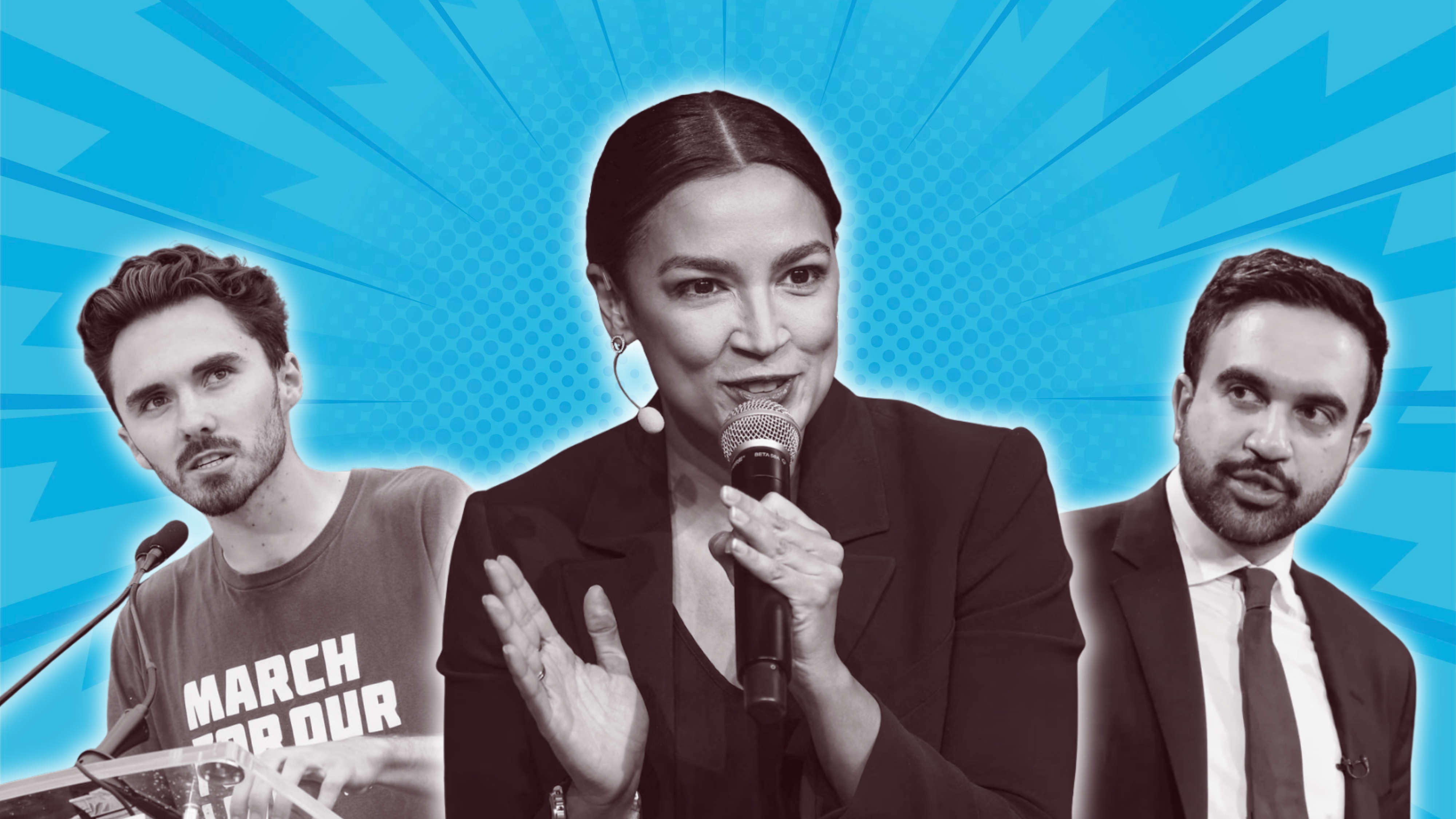
Of course, any powerful politician cemented in their seat for decades would be terrified of a sudden upheaval from within. David Hogg, the founder of an organization working to elevate young challengers against established incumbents, previously worked as vice chair at the Democratic National Committee (DNC). In 2025, when Hogg announced that the DNC would support challenges to incumbents who are “unwilling to meet the moment,” Democrats quickly forced him out of his prestigious position in party leadership [19]. In a similar fashion, the Tea Party itself faced notable resistance from the Republican establishment. Karl Rove, deputy chief of staff in the Bush White House and a prominent figure in Republican politics, even created a super PAC to put down the internal revolution in his party [20].
Yet, today, despite the initial hesitation from the Republican establishment, many Tea Party ideals are considered mainstream among conservatives. In fact, much of President Trump’s Make America Great Again (MAGA) platform would not exist if it weren’t for the Republicans’ lunge to the right during the Obama presidency. When he ran for president in 2016, Trump absorbed much of the Tea Party base. His “drain the swamp” rhetoric is almost identical to the messaging of Tea Party candidates from 2010. In a sense, MAGA is simply the political descendant of the Tea Party [21].
What the Democratic establishment needs to realize is that it is failing to rise to the occasion, and its base is noticing. Democrats have spent too much time trying to appeal to the middle-of-the-road voter, and it’s gotten them nowhere. The establishment’s intentions have been clear in every strategic decision they’ve made: refusing to endorse Zohran Mamdani, forcing David Hogg out of the DNC, and even selecting Tim Walz as the vice presidential candidate. They are constantly trying to please moderates, and they are losing large swaths of liberals in their own base as a result.
Take the 2024 election—the point of origin for the Democratic Party’s much-needed reset. There were fewer total votes cast in 2024 than in 2020, a rare occurrence in American elections [22]. The primary source of that phenomenon was the fact that Kamala Harris received significantly fewer votes than Joe Biden did just four years prior, falling from Biden’s 81 million in 2020 to 75 million in 2024. Trump’s total number of votes didn’t increase by much; rather, Harris’ loss was a result of a nosedive in support from the Democratic Party’s own voters [23].
Naturally, Harris’ strategy in her 2024 run for the presidency emulated that of Joe Biden, an establishment Democrat who succeeded in his quest for the White House while catering to moderate voters. Only this time, voters didn’t reward that strategy with a four-year term in the nation’s highest office; they chose MAGA instead. In a day and age of soaring motivation and vigor within the GOP, it’s no longer sufficient for Democrats to rely on moderates to carry them across the finish line, especially when their base has a palpable appetite for change. That message was crystal clear in the 2024 returns.
There were many warning signs that this could happen leading up to Election Day. In Dearborn, Michigan, Arab American voters withheld their support for Harris because she refused to call Israel’s actions in Gaza a genocide and took millions of dollars from PACs tied to Israel [24]. Many establishment Democrats have also been shaky on DEI and LGBTQ issues, particularly refusing to defend the transgender community [25]. Their spinelessness has caused them to lose minorities, young people, and working-class voters who used to be the backbone of the party’s electorate [26]. This, at its very core, is the problem with the Democratic Party. They do not actually stand for the things they claim to represent, and their own base views them as cowards because of it. The instant their policies are questioned, Democrats fold, hoping they don’t lose the centrist vote.
Meanwhile, the Republicans’ pivot to the right has been stunningly successful while doing the exact opposite. The Tea Party and MAGA agendas have elevated some of the farthest right viewpoints in today’s wide range of issues. From claiming migrants are eating people’s pets to Trump’s selection of J.D. Vance as his running mate, Republicans have realized that making bold, audacious, and sometimes ludicrous choices will succeed against a party that caters to moderates and lacks true convictions or a vision it is willing to fight for.
The best move for Democrats is to pass the torch to a more progressive generation of leaders who are unafraid to stand up for their beliefs, instead of keeping it in the hands of incumbents who are still playing by the old set of rules. Nancy Pelosi’s decision not to run for reelection and instead make way for new, progressive leadership is an example that other Democratic incumbents must follow. The lesson of 2010 is not that Republicans got lucky—it’s that they were willing to look inward, embrace change, and rebuild a party that was secure in its values. The Tea Party proved that winning doesn’t come from endlessly chasing the support of moderate voters, but from giving the base something to believe in. If Democrats want to win big in 2026, they need to stop pretending that discontent in their party doesn’t exist and start harnessing it to build something stronger. The Democrats’ Tea Party moment is knocking on the door; they just need to be brave enough to let it in.
Sources
[1] Connolly, Katie. “What Exactly Is the Tea Party?” BBC News, September 16, 2010. https://www.bbc.com/news/world-us-canada-11317202.
[2] “How ‘shellacking’ Came to Mean ‘Defeat.’” NPR, November 4, 2010. https://www.npr.org/2010/11/04/131075640/how-shellacking-came-to-mean-defeat.
[3] “Seats in Congress Gained/Lost by the President’s Party in Mid-Term Elections.” The American Presidency Project, December 6, 2022. https://www.presidency.ucsb.edu/statistics/data/seats-congress-gainedlost-the-presidents-party-mid-term-elections.
[4] “2010 United States Senate Elections.” Wikipedia, January 9, 2026. https://en.wikipedia.org/wiki/2010_United_States_Senate_elections#Retirements.
[5] “2010 United States House of Representatives Elections.” Wikipedia, January 24, 2026. https://en.wikipedia.org/wiki/2010_United_States_House_of_Representatives_elections#Retiring_incumbents.
[6] Rosenberg, Stacy. “Section 2: Views of the Parties and Their Leaders.” Pew Research Center, July 1, 2010. https://www.pewresearch.org/politics/2010/07/01/section-2-views-of-the-parties-and-their-leaders/.
[7] “Democratic Party Favorability.” RealClearPolling. Accessed January 26, 2026. https://www.realclearpolling.com/polls/favorability/democratic-party.
[8] Bianco, Ali. “Nancy Pelosi Faces Primary Challenge from Former AOC Aide.” POLITICO, February 5, 2025. https://www.politico.com/news/2025/02/05/nancy-pelosi-faces-primary-challenge-from-former-aoc-aide-00202781.
[9] “New York City Mayoral Election Live Results 2025: Mamdani Wins.” The New York Times, December 11, 2025. https://www.nytimes.com/interactive/2025/11/04/us/elections/results-new-york-city-mayor.html.
[10] Basu, Zachary. “Zohran Mamdani Taps Progressive Playbook for Electrifying Gen Z.” Axios, June 21, 2025. https://www.axios.com/2025/06/21/zohran-mamdani-gen-z-playbook-new-york-mayor.
[11] Kamisar, Ben, Bridget Bowman, and Joe Murphy. “More Democrats Are Facing Well-Funded Primary Challengers as the Party Reckons with Its Future.” NBC News, October 16, 2025. https://www.nbcnews.com/politics/2026-election/democrats-are-facing-well-funded-primary-challengers-party-reckons-fut-rcna237798.
[12] Alaigh, Arvin. “The primary win that stunned Democrats everywhere.” The Nation, February 20, 2026.
https://www.thenation.com/article/politics/analilia-mejia-new-jersey-primary-aipac-ice/.
[13] Amadeo, Kimberly. “The Tea Party Movement’s Effect on the Republican Party.” The Balance, December 3, 2020. https://www.thebalancemoney.com/tea-party-movement-economic-platform-3305571.
[14] Robbins, Liz. “Tax Day Is Met With Tea Parties.” The New York Times, April 15, 2009. https://www.nytimes.com/2009/04/16/us/politics/16taxday.html.
[15] “Economic Confidence Index.” Gallup, January 3, 2026. https://news.gallup.com/poll/1609/consumer-views-economy.aspx.
[16] Doherty, Erin. “Trump Tariffs Are Fueling Inflation, Congressional Budget Chief Says.” CNBC, September 15, 2025. https://www.cnbc.com/2025/09/15/trump-trade-inflation-tariffs-cbo.html.
[17] Roeder, Amy. “Health Insurance Premiums Are Rising-Here’s Why.” Harvard T.H. Chan School of Public Health, February 4, 2026. https://hsph.harvard.edu/health-policy-management/news/health-insurance-premiums-are-rising-heres-why/.
[18] Gallup. “Most Important Problem.” Gallup, February 10, 2026. https://news.gallup.com/poll/1675/most-important-problem.aspx.
[19] Bryson, Anne. “DNC Leaders Challenge David Hogg’s Efforts to Unseat Incumbents with Public Warning.” CBS News, April 24, 2025. https://www.cbsnews.com/news/democrats-david-hogg-incumbent-challenges/.
[20] McKay, Tom. “Karl Rove Takes on the Tea Party to Save the GOP from Itself.” Mic, February 3, 2013. https://www.mic.com/articles/24766/karl-rove-takes-on-the-tea-party-to-save-the-gop-from-itself.
[21] LaLoggia, John. “Trump’s Staunch GOP Supporters Have Roots in the Tea Party.” Pew Research Center, May 16, 2019. https://www.pewresearch.org/politics/2019/05/16/trumps-staunch-gop-supporters-have-roots-in-the-tea-party.
[22] “Voter Turnout in United States Presidential Elections.” Wikipedia, January 14, 2026. https://en.wikipedia.org/wiki/Voter_turnout_in_United_States_presidential_elections.
[23] “2024 Election Results Map: Trump Wins.” The New York Times, March 4, 2025. https://www.nytimes.com/interactive/2024/11/05/us/elections/results-president.html.
[24] Perry, Caitriona. “Uncommitted’ Anger over Gaza Threatens Harris in Michigan.” BBC News, September 20, 2024. https://www.bbc.com/news/articles/c8xejx07exro.
[25] Thompson, Alex, and Erin Doherty. “Democrats Splinter over Trans Rights, DEI.” Axios, March 10, 2025. https://www.axios.com/2025/03/10/democrats-transgender-rights-dei.
[26] Hartig, Hannah. “Behind Trump’s 2024 Victory, a More Racially and Ethnically Diverse Voter Coalition.” Pew Research Center, June 26, 2025. https://www.pewresearch.org/politics/2025/06/26/behind-trumps-2024-victory-a-more-racially-and-ethnically-diverse-voter-coalition/?utm_source=chatgpt.com.
[27] Krales, Alex. “Mayor Zohran Mamdani explains his first preliminary budget during a City Hall press conference.” The City, February 17, 2026. https://i0.wp.com/www.thecity.nyc/wp-content/uploads/2026/02/021726_mamdani_budget_presentation-4.jpg?fit=1200%2C800&ssl=1.
[28] Johannssen, Liesa. Rep. Alexandria Ocasio-Cortez (D-New York) at the Munich Security Conference on Friday. The Washington Post, February 2026. https://www.washingtonpost.com/wp-apps/imrs.php?src=https://cloudfront-us-east-1.images.arcpublishing.com/wapo/34TXY77EMJGVS6YE3RJXX2MVFE.JPG&w=1440.
[29] David Hogg speaking at a March For Our Lives event. NBC News, December 2024. https://media-cldnry.s-nbcnews.com/image/upload/rockcms/2024-12/241216-david-hogg-vl-1046a-7e47f5.jpg.