
Colorblind Constitutionalism and Its Consequences: Evaluating the stakes of Louisiana v. Callais
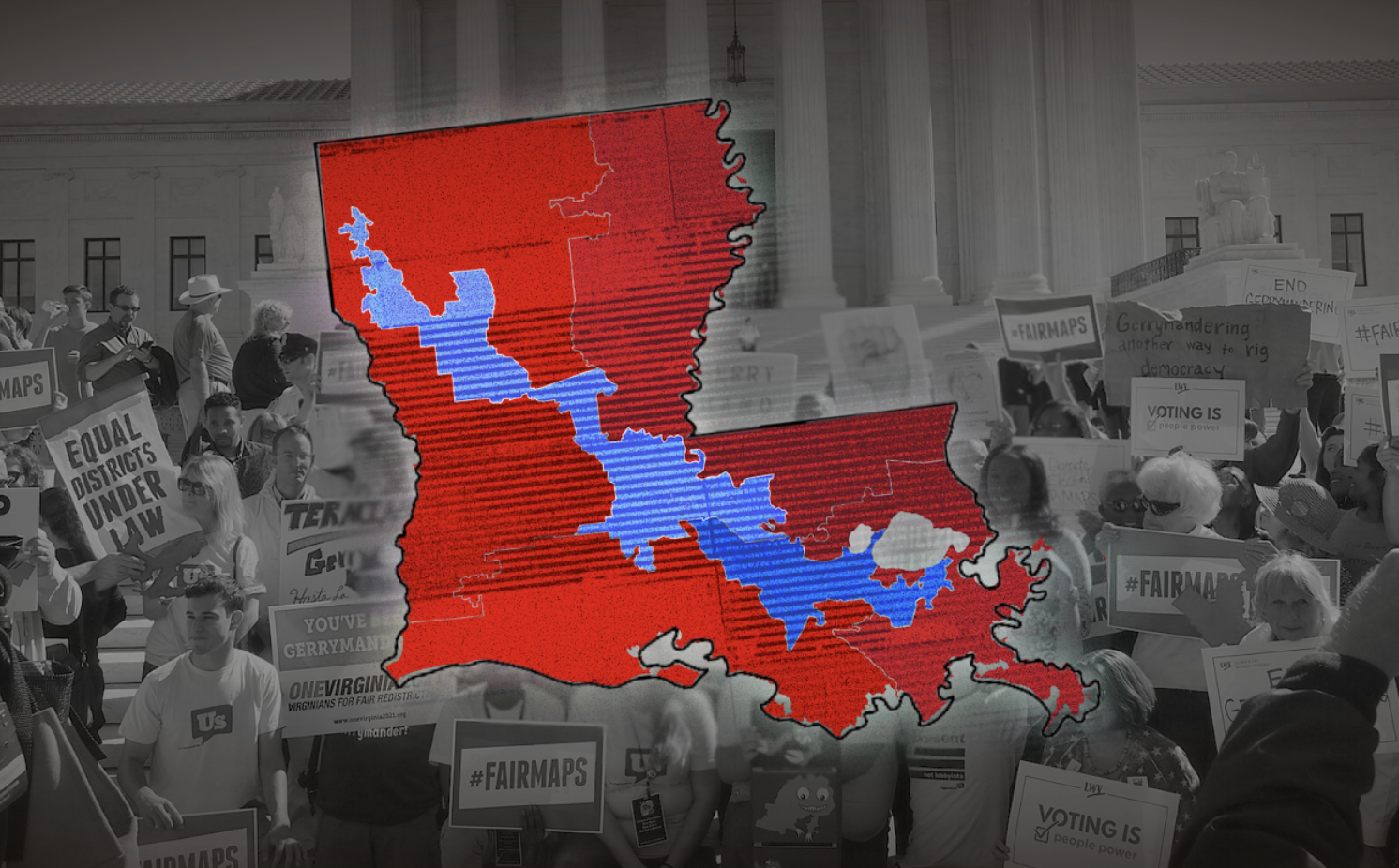
The United States Supreme Court may be on the verge of rolling back another major piece of legal precedent. The case Louisiana v. Callais presents the Court with a clear opportunity to gut key provisions of the landmark Voting Rights Act of 1965, primarily targeting Section 2, which, along with the Fourteenth and Fifteenth Amendments, has functioned as a ban on racial gerrymandering for the past sixty years. Should the Court side with Callais, protections concerning the representation of racial minorities would be completely dismantled, causing America’s elected officials to no longer be fully representative of its people, ultimately undermining the Constitution’s design of a Congress with fair and equal representation.
Gerrymandering and the Voting Rights Act
In the early 19th century, Massachusetts Governor Elbridge Gerry signed into law a salamander-shaped legislative map to benefit his party, the Democratic-Republicans. Thus, a political monster was born: the “gerrymander,” a term used to describe the drawing of unusual district lines that intentionally amplify the voting power of a certain group while diluting the impact of others [3].
Throughout history, gerrymandering has been a popular mechanism used by politicians to undermine the will of voters. It was a cornerstone of Jim Crow laws enacted to dilute African American voters following the ratification of black suffrage in the Fifteenth Amendment [4]. However, in the midst of the Civil Rights Movement, the landmark Voting Rights Act of 1965 banned all discriminatory, race-based voting practices, meaning any maps that diluted the voting power of racial minorities could violate federal law [5]. Before the V.R.A., no guardrails existed to protect the fair representation of minorities in the House of Representatives. The absence of congressional representation led to a lack of attention and solutions for issues facing minorities across the nation.
Once again, all of that is at stake.
Examining Louisiana v. Callais
Fast forward to the modern day. Although one-third of Louisiana’s population is African American, in 2021, the state drew a map with only one majority-black district out of the six total districts allocated by the census. To comply with the V.R.A., the U.S. District Court for the Middle District of Louisiana mandated that the state draw an additional majority-black district, ensuring that the state’s congressional delegation aligned with its demography. Such was the origin of the case now before the Supreme Court: Louisiana v. Callais.
Phillip Callais, a Louisiana resident, spearheaded a movement with other white voters to challenge the V.R.A. Their argument is founded on the idea that forcing Louisiana to use race as the primary factor in the drawing of its Congressional maps is unconstitutional. According to those arguing for Callais, the Equal Protection Clause of the Fourteenth Amendment and the Fifteenth Amendment suggest that the use of race in drawing Congressional maps is inherently discriminatory. Essentially, they’re suing the state of Louisiana, arguing that the V.R.A. discriminates against white voters [6].
This case threatens a long-standing precedent in civil rights law, presenting one of the thickest ironies to have come before the Supreme Court. The Callais argument relies on the Court finding the V.R.A., a key piece of anti-discrimination legislation, discriminatory. Callais is blaming the V.R.A. for racially gerrymandering white voters—if the Court sides with them, racial gerrymandering will increase exponentially.
The NAACP, A.C.L.U., and other civil rights organizations are all involved in defending the V.R.A., arguing on the side of Louisiana. They reason that the methods used to draw the state’s maps did not violate the Equal Protection Clause or any other part of the Constitution. Louisiana state legislators and officials, who drew the original non-representative maps, have outwardly supported Callais [7].
The Court Seemed Open to Callais’s Argument
The 6-3 ideologically conservative majority on the Supreme Court heard oral arguments on Louisiana v. Callais in March 2025 and again in mid-October of the same year. During their second hearing in October, many statements from the conservative justices on the Court seemed to provide clear evidence that they were open to gutting Section 2 of the V.R.A. Trump appointee Justice Neil Gorsuch, for instance, stated, “once you've found a Section 2 violation, you've got a compelling interest to go ahead and discriminate on the basis of race in your remedial map.” This elevates the argument that the V.R.A. is somehow discriminatory to white voters [8]. This reasoning reflects a fundamental misinterpretation of the purpose of Section 2. Congress did not create the V.R.A. to give extra protections to one race over another, but to ensure a level playing field for all racial groups in the political process.
Perhaps most notable was conservative Justice Brett Kavanaugh, who said, “race-based remedies are permissible for a period of time, sometimes for a long period of time, decades, in some cases, but that they should not be indefinite and should have an endpoint.” In essence, Justice Kavanaugh is brazenly suggesting that civil rights are intended to sunset after a certain period of time, even though Section 2 lacks any sort of language that schedules civil rights to expire [9]. If America accepts the idea that civil rights are intended to sunset, racial gerrymandering will be only the first stone to fall. The country would quickly plunge into a dangerous cascade of more rights being lost by the day.
This new conservative argument weaponizes the idea of a “colorblind” Constitution to dismantle federal laws that are in place to achieve racial equity. It ignores centuries of structural inequality that have systematically held back racial minorities in America, some of which still exist today. By accepting this logic, the conservatives on the Supreme Court appear likely to strike down Section 2 of the V.R.A.
Such was the basis of a June 2023 ruling in Students for Fair Admissions v. Harvard, which may provide critical insight into how the Court will rule in Louisiana v. Callais. In a landmark decision, the Court ruled that the use of affirmative action in college admissions is unconstitutional. The S.E.F.A. case has many parallels to the case currently before the Court, namely, the constitutionality of using race to achieve remedial or social goals. In S.E.F.A., white college applicants argued that affirmative action was a remedial practice that inherently discriminated against them. All six conservative justices on the Court agreed, deeming affirmative action unconstitutional [10]. Kavanaugh is making this same argument here.
Meanwhile, on the opposite side of the spectrum, Biden appointee Justice Ketanji Jackson Brown remarked in the October hearing that “Section 2 is not a remedy in and of itself. It is the mechanism by which the law determines whether a remedy is necessary.” Brown argues ultimately that not only is Section 2 fully constitutional, but it also upholds the Fifteenth Amendment [11]. In short, she suggests that the V.R.A. isn’t a corrective action at all, but rather a tool for deciding whether one is needed.
At the end of the day, the conservative justices are indeed the ones who hold the majority on the Court. Based on statements made during oral arguments and their positions on previous rulings, conservatives appear likely to undo the protections of the V.R.A., with Justice Amy Coney Barrett and Chief Justice John Roberts appearing as the only possible surprise votes. The liberals seem likely to dissent from the would-be majority.
America Post-Callais
If the Court were to gut Section 2 of the V.R.A., the largest effect, by far, would be on the makeup of the U.S. Congress. All national standards concerning the use of race in redistricting would instantly evaporate. More than one in three congressional districts are majority-minority districts—they could all be drawn out of existence [12]. The foundational American principle of representative democracy would lose perhaps its most important pillar.
In the midst of a mid-decade redistricting battle, states across the nation have proven they are willing to gerrymander their maps to deny fair representation based on party; the fall of Section 2 of the V.R.A. would only add fuel to this fire, and that fuel would be much more potent. President Trump has set off a nationwide gerrymandering arms race that has left many states’ congressional maps with significant partisan advantages [13]. Stripping the V.R.A. of some of its key protections would open the floodgates to a surge in racial gerrymandering, the likes of which have not been seen since the pre-Civil Rights era. Now, more than ever, the gutting of the V.R.A. would be absolutely detrimental to the function of democracy.
The final verdict in Louisiana v. Callais will reveal whether the Supreme Court believes equal representation is a fundamental American value and constitutional principle or if it feels it is a relic of the past. Striking down Section 2 of the V.R.A. would ignore centuries of racial inequity and cement white politicians in their seats indefinitely, eroding the very foundation of representative democracy. As of now, the Voting Rights Act of 1965 remains intact, but the fate of minority representation now rests in the hands of the nine justices on the nation’s highest court.
Sources
[1] Dashing24. 2024 Louisiana Presidential Election by Congressional District. December 5th, 2024. Wikipedia. https://commons.wikimedia.org/wiki/File:2024_Louisiana_Presidential_Election_by_Congressional_District.svg.
[2] Slowking4. Gerrymandering 032630. October 3rd, 2017. Wikipedia. https://commons.wikimedia.org/wiki/File:Gerrymandering_032630.jpg.
[3] Tucker, Neely. “Gerrymandering: The Origin Story: Timeless.” The Library of Congress. July 18th, 2024. https://blogs.loc.gov/loc/2024/07/gerrymandering-the-origin-story/.
[4] U.S. Congress. “52 U.S. Code § 10101 - Voting Rights.” Legal Information Institute. Accessed November 3rd, 2025. https://www.law.cornell.edu/uscode/text/52/10101.
[5] “What We Know about Redistricting and Redistricting Reform.” New America. Accessed November 3rd, 2025. https://www.newamerica.org/political-reform/reports/what-we-know-about-redistricting-and-redistricting-reform/where-we-have-been-the-history-of-gerrymandering-in-america/.
[6] VanSickle, Abbie. “Who Are the Louisiana Voters behind a Major Supreme Court Challenge?” The New York Times. October 12th, 2025. https://www.nytimes.com/2025/10/12/us/politics/supreme-court-voting-rights.html.
[7] “Louisiana v. Callais.” Legal Defense Fund. October 15th, 2025. https://www.naacpldf.org/case-issue/louisiana-v-callais/.
[8] “Arguments Transcripts.” Supreme Court of the United States. October 15th, 2025. https://www.supremecourt.gov/oral_arguments/argument_transcript/2025.
[9] “Argument Transcripts.”
[10] “Argument Transcripts.”
[11] “Students for Fair Admissions v. President and Fellows of Harvard College.” Oyez. Accessed November 3rd, 2025. https://www.oyez.org/cases/2022/20-1199.
[12] “Majority-Minority Districts.” Ballotpedia. Accessed November 3rd, 2025. https://ballotpedia.org/Majority-minority_districts.
[13] Chen, David. “A State-by-State Guide to the Gerrymandering Fight for Congress.” The New York Times. November 5th, 2025. https://www.nytimes.com/2025/11/05/us/politics/congress-gerrymander-redistricting-elections.html.