A Means of Protecting the Independence of American Arts
The ongoing Trump presidential term has been characterized by further reactionary action than in his first term. Many actions that he was unable to engage in during his first term as a result of an intervening Congress, a more sensible cabinet, and a less polarized American public are no longer withheld by such gatekeepers [1]. President Trump, in what he sees as a greater sense of agency, is attempting to exert his will in expanding facets of American society. Few areas are so evident of this expansion as in Trump’s tirade against the arts. However, the Trump administration is not the first to use the arts for its personal gain, and unless systemic change is made, it is unlikely to be the last. Trump has noticed, as have many before him, that the people of the United States have historically been captivated by the arts.
In the first weeks of 1776, Thomas Paine published Common Sense, a call for a complete separation from the United Kingdom, and for the installation of a new democratic republican government [2]. Paine argued that reconciliation was impossible and that monarchy was a flawed system incompatible with the future of the colonies [3]. The pamphlet galvanized Colonial America. Around 120,000 copies of the work were sold in the first three months, and an estimated 500,000 were sold by the end of the Revolutionary War [4]. Along with these massive sales came a shift in public opinion. Prior to the work’s publication, many colonists felt that they were better off remaining as subjects of the British Crown. As colonists had never seen a nation succeed without a monarch, they were unable to imagine a “monarchless” government even in the chance of a successful military pursuit. Common Sense provided them a roadmap. A successful revolution was no longer implausible, but by a significant margin, the most reasonable path [5].
As the nation developed, literature—and art as a whole—continued to influence the American zeitgeist. Works like Ralph Waldo Emerson’s Self Reliance pushed American individualism and kindled the flames of an American identity of dominance in their own sovereignty and harmony with the natural world [6]. Abolitionist writings such as Frederick Douglass’s Narrative of the Life of Frederick Douglass, an American Slave and Harriet Beecher Stowe’s Uncle Tom’s Cabin elucidated to the American public the harsh conditions of America’s enslaved populations, inciting action against such institutions [7]. And post-industrial works, like Upton Sinclair’s The Jungle, even led to government action in the creation of the Food and Drug Administration (FDA) as it brought to light unhygienic meat production practices [8].
The United States is a nation captivated by a story. When individuals notice injustice in their surroundings, they have the power to portray a better ideal in their work. Historically, these ideals have also carried change. However, the influence of American art is a power not only vested in those seeking justice. Governments across the world—and in the United States—have co-opted the power of art to exert their own influence on their publics. In the United States, for example, sentiment towards domestic Japanese populations during WWII was negatively tainted by racist caricatures of Japanese individuals. Particularly, anti-Japanese art can be seen in the early works of the renowned American illustrator, Dr. Seuss, the pen name of Theodor Seuss Geisel [9]. Such depictions created a public that did not care that their fellow citizens were imprisoned in internment camps, as they were of Japanese heritage.
The example of the sway racist caricature art had on public sentiment towards Japanese Internment demonstrates the danger of art when weaponized by a government. Art, when created to uplift the same people it is created by, serves to establish a message that will benefit its creator and its observers, especially for communities that have faced historical discrimination. When created by a small group of elites or a government, isolated from its people, manipulative and harmful art may be pushed without any fear of potential repercussions from its influence.
Maybe the greatest example of the American propaganda machine is the Red Scare. Post-WWII, the United States entered an era of global dominance, where the previous superpowers of Western Europe were left damaged and forced to focus on domestic concerns as they rebuilt. In the subsequent power vacuum, the United States expanded its sphere of influence across the Western world as the Soviet Union did the same with the Eastern [10]. Fearing this challenge, the United States pursued an internal cleanse.
Such a cleanse was posed to the arts industry in two ways: the immediately evident physical criminal threat, and the modernly recognized, albeit then-subtle, general cultural shift. The physical criminal threat is the more commonly identified tactic associated with the Red Scare when discussions of the political era occur. The hearings of Senator McCarthy and the House Un-American Activities Committee(HUAC) were used as the medium for removing any individual who had any possible inclination toward the Soviet Union or communist ideology in general [11]. Yet these inclinations had no requirement of being factually based or even fully proven before action was taken against challenged individuals. Often, charges were brought against individuals as a result of their personal identity, such as their ethnicity, sexual orientation, or occupation [12].
One such targeted occupation was filmmaking—not individuals in government or federal agencies, but creators of art. In October of 1947, a group of ten screenwriters, directors, and motion-picture producers was brought in front of the HUAC to testify for their supposed associations with communism [13]. In staunch defense of their First Amendment rights, the aptly named “Hollywood Ten” refused to testify during the trial and were held in contempt of Congress [14]. Not only did they face the legal punishments of a $1,000 fine and a prison sentence of 6-12 months, but they were blacklisted from the industry, and no other filmmakers were willing to work with them after the incident [15].
The second, more veiled portion of the cleanse involved a cultural shift away from any art deemed “obscene.” Even prior to the period of the Red Scare, American art had limited what could be expressed in art. The Hays Code—enforced beginning in 1934—existed just as that, a means to limit content in film [16]. The Code was a set of rules that limited what could be included in motion pictures, and how certain topics were allowed to be portrayed [17]. The Red Scare then only served to fuel this culture. The Soviet Union, and its principles of Marxist-Leninist Communism, prioritized state-sponsored atheism, where policy focused on suppressing religious belief, and making the state the religion of the people [18]. In an attempt to counter these principles, the United States chose to amplify its own faith. By deprecating their opponent’s godlessness, policymakers in the United States sought a moral high ground.
This public relations campaign was evident. In 1954, President Dwight D. Eisenhower signed a law adding “Under God” to the Pledge of Allegiance [19]. Two years later, he signed another law, enshrining “In God We Trust” as the official motto of the United States [20]. The phrase became mandated on US currency, was installed on government facilities, and became a part of everyday life through repetition, like the pledge of allegiance [21]. In this constant affirmation of one’s faith and of the faith of the nation, the principles of such a faith became exaggerated in the public conscience. What were previously more private personal regulations became a way to denote yourself as more American. Faith became a competition. The more godly you were, the more you were doing to fight communism and support your own nation. The Puritan values of American Protestantism became the primary American aspiration.
These traits of faith and godliness were applied to the arts as well. An industry historically defined by rebellion and challenging dominant narratives was forced to become one of compliance. A field that would often require obscene topics was no longer allowed. And while artists continued to produce these works, the Hollywood mainstream was no longer willing to engage with these arts, effectively nullifying the art to make any change and do any work [22].
Combined with a hyper-engagement in capitalism as a part of the fight against communism—where citizens were directly encouraged to independently support the war effort through purchasing government bonds, growing their own produce for their family, and a greater push towards preserving limited capital—this sanitization of what is marketable art created the modern arts industry, where art has no message, and its priority is catching one’s eye [23]. Functionally, the arts have blossomed as a result of this commercialization. While art as a political or thematic statement has lost some of its emphasis, art as defined as purely the application of human skill and imagination in a visual or auditory format has become inseparable from commerce.
In recent years, art as a commercial industry has had a major boom. During the COVID-19 pandemic, the industry suffered major losses, but that has largely reversed [24]. Since then, the arts have added $1.2 trillion to the American economy [25].
The commercialization of art has left a vacuum wherein public interaction with works that challenge them has been severely limited. Art that is likely to have commercial success is likely to be less controversial and appeal to a greater audience. Yet, as a species, we grow by interacting with art that challenges us. We learn by reading words, by listening to speech, and by hearing songs [26]. So much so, in fact, a juvenile human who has not effectively experienced language through these arts by a certain age effectively becomes mentally disabled, and can no longer fully learn language or human culture [27]. Our society is much the same. We are stunted if we do not have art that challenges us.
Thus this desire for art with a message is one that can be capitalized on even more efficiently than in prior instances of propaganda. Such is the case with the current Trump administration, which has limited expression in the arts that oppose his views [28]. In fact, two days after his inauguration, President Trump dissolved the President’s Committee on the Arts and the Humanities, which had been reinstalled by President Biden after Trump removed it in his first term [29].
Many of the limitations Trump has placed on the free expression of the arts are via limitations or qualifications on the receipt of federal funding for art productions. One example is the National Endowment for the Arts (NEA), which, under Trump, has experienced limited funding and more lengthy or difficult application processes [30]. Particularly, these limitations have affected minority communities. One particular grant of the NEA limited by Trump was the Challenge America Grant, a grant afforded to artists from underserved communities, which was entirely canceled [31].
One group Trump has taken extensive shots at is the LGBTQ+ community, particularly transgender individuals. Many of the restrictions he has placed on arts funding require limitations on content that “promote[s] gender ideology” [32]. This tirade against “gender ideology” has expanded further to Trump’s takeovers of American arts institutions. In February of 2025, less than a month after his inauguration, and limitations on the NEA, Trump removed every member of the 36-member board, as well as the chair, a role in which he installed himself [33]. The board, previously bipartisan, composed of an equal number of Republicans and Democrats, was entirely replaced by his appointees [34]. President Trump additionally set new guidelines, similarly limiting any content performed about diverse gender expression, notably the performance artform drag [35].
Notably, with the case of the Kennedy Center, Trump is not facing financial success. The Kennedy Center has seen plummeting ticket sales, the lowest since the COVID-19 pandemic [36]. The drops have even necessitated outreach to previous contributors and customers, many of whom are boycotting in the wake of the Trump takeover. Such financial performances display a motivation that is not fiscal in nature. The changes are not affording any increased revenue to either the Kennedy Center or the federal government.
Trump has additionally pursued a nationalistic limitation on American arts. He has indicated a desire to place tariffs on foreign-made films [37]. The nature of contemporary motion-picture production has become nearly entirely globalized. There are almost no films, save for small indie productions, that are entirely produced in the United States. Whether in travel for sets, equipment production abroad, offshore editing or animating, international casting, or even international hiring for any of the many roles of production [38]. In essence, this action would allow Trump a blank check. Any film he considers “international” can and will be limited.
In order to prevent such limitations, an independent commission on the arts must be created. The current system of an advisory committee has proven to be unable to withstand pressures from an authoritarian administration. Rather, an independent board, akin to the Federal Reserve, must be created that has a greater say in the financial distribution of federal grants.
The system of appointments for the Board of Governors of the Federal Reserve System is characterized by staggered terms, where one term begins every two years, allowing a president to appoint two governors in their term [39]. These positions are nominated by the President and confirmed by the Senate, supporting a fair balance of powers [40]. Many of the other nuances of the Federal Reserve Board of Governors would also apply to this Independent Arts Board. Particularly, the system of committees would apply to differing forms of art. There would be committees for visual, performing, and musical arts, with sub and joint committees for each regarding art forms that may exist across multiple lines. With internal committees and internal elections regarding said committees, artists on the board with different works in different fields will be able to govern from their relevant experience when appropriate. The greater diversity in the many arts fields may also support a larger governing body, perhaps triple or even five times the seven Governors of the Federal Reserve.
Recently, Jane Fonda, along with other performers such as Barbra Streisand, has revitalized the Committee for the First Amendment, a group originally pioneered by Jane Fonda’s father, Henry Fonda, and stars of his generation, like Judy Garland [41]. The original Committee was founded to fight the limitations on art posed during the McCarthy era, and the new one is serving to fight similar limitations under President Trump, through targeted protest and boycott campaigns, and use of their influence to lobby legislators and the public [42].
Artists have proven that they have the means and the motivation to protect their own communities. Thus, a new independent committee must be created with them at the helm. Funding in grants, from the NEA, and in the many federal institutions of art, should be decided by those who have experience in these industries. The nature of art requires that its support remain in the hands of the people who make it, not at the behest of whatever political force happens to sit in the seat of power. It is categorical that the developmental nature of the arts is not manipulated by an uninvolved elite.
Sources
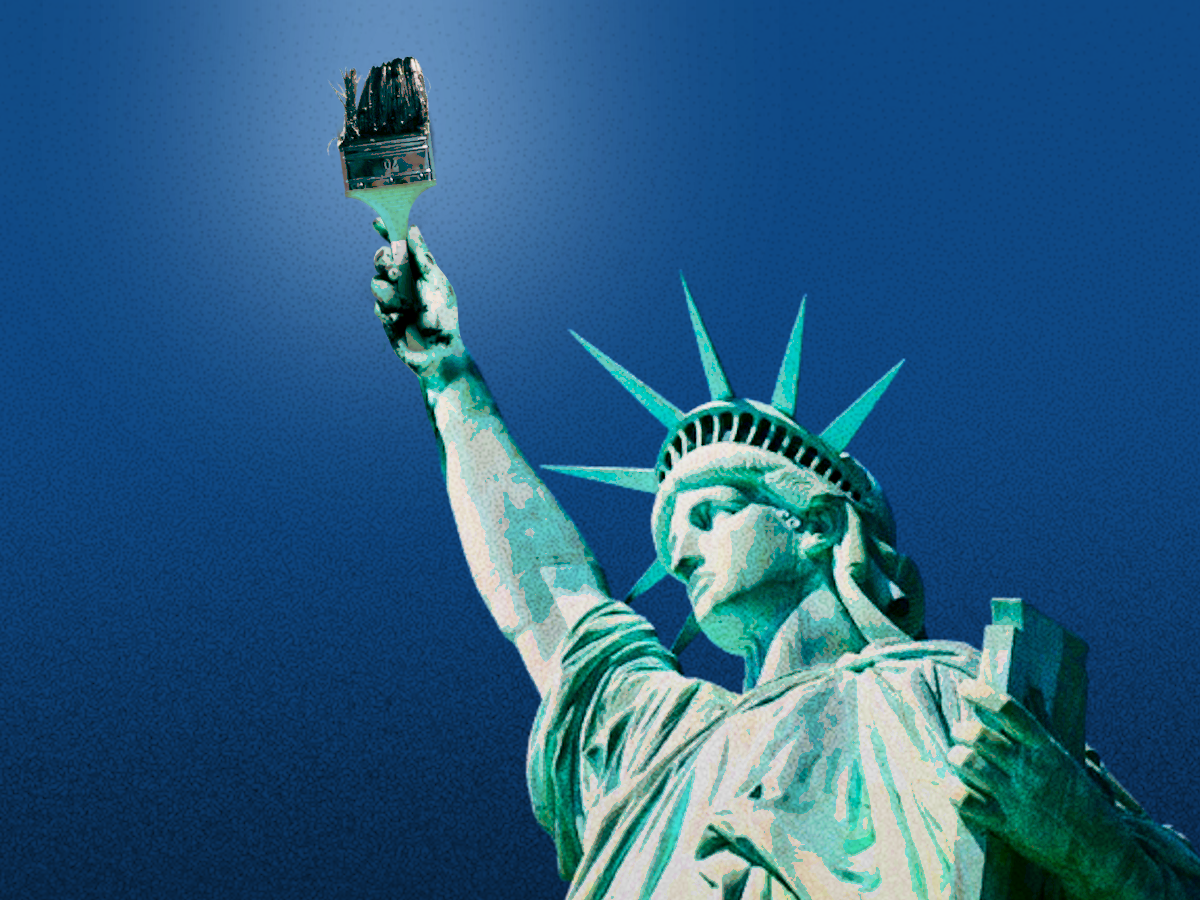
Illustration by BPR graphic designer Kiet Huynh
[1] Gracia, Shanay. “As Democrats’ anger spikes, Americans’ feelings about the federal government grow more polarized.” Pew Research Center. December 4th, 2025. https://www.pewresearch.org/short-reads/2025/12/04/as-democrats-anger-spikes-americans-feelings-about-the-federal-government-grow-more-polarized/.
[2] Paine, Thomas. “Common Sense.” American Battlefield Trust. January 10th, 1776. https://www.battlefields.org/learn/primary-sources/common-sense.
[3] Paine, “Common Sense.”
[4] NCC Staff. “Thomas Paine: The original publishing viral superstar.” National Constitution Center. January 10th, 2023. https://constitutioncenter.org/blog/thomas-paine-the-original-publishing-viral-superstar-2.
[5] NCC Staff, “Thomas Paine.”
[6] Stanford Encyclopedia of Philosophy Staff. “Ralph Waldo Emerson.” Stanford Encyclopedia of Philosophy. January 3rd, 2002, revised October 21st, 2021. https://plato.stanford.edu/entries/emerson/.
[7] PBS Socal “Slave narratives and Uncle Tom's Cabin.” PBS. https://www.pbs.org/wgbh/aia/part4/4p2958.html.
[8] Klein, Christopher. “How Upton Sinclair’s ‘The Jungle’ Led to US Food Safety Reforms.” History. May 10, 2023, revised May 27th, 2025. https://www.history.com/articles/upton-sinclair-the-jungle-us-food-safety-reforms.
[9] Minear, Richard. “Dr. Seuss and Japan, December 1941.” Association for Asian Studies. Winter, 1999. https://www.asianstudies.org/publications/eaa/archives/dr-seuss-and-japan-december-1941/.
[10] Burton, Kristen D. “Great Responsibilities and New Global Power.” The National WWII Museum, New Orleans. October 23rd, 2020. https://www.nationalww2museum.org/war/articles/new-global-power-after-world-war-ii-1945.
[11] Schultz, David. “House Un-American Activities Committee.” Free Speech Center at Middle Tennessee State University. January 1, 2009, revised July 9th, 2024. https://firstamendment.mtsu.edu/article/house-un-american-activities-committee/#.
[12] Adkins, Judith. ““These People Are Frightened to Death” Congressional Investigations and the Lavender Scare.” National Archives. Summer 2016, Vol. 48, No. 2. https://www.archives.gov/publications/prologue/2016/summer/lavender.html.
[13] Britannica Editors. "Hollywood Ten." Encyclopedia Britannica, June 21st, 2025. https://www.britannica.com/topic/Hollywood-Ten.
[14] Britannica Editors, “Hollywood Ten.”
[15] Britannica Editors, “Hollywood Ten.”
[16] Rosenfeld, Jordana "Hays Code." Encyclopedia Britannica, April 12, 2025. https://www.britannica.com/art/Hays-Code.
[17] Rosenfeld, “Hays Code.”
[18] Majeska, George P. “Review of Work: Religion and Atheism in the U.S.S.R. and Eastern Europe by Bohdan R. Bociurkiw, John W. Strong.” The Slavic and East European Journal 20, no. 2 (1976): 204–6. https://doi.org/10.2307/305838.
[19] The American Presidency Project, “Statement by the President Upon Signing Bill To Include the Words "Under God" in the Pledge to the Flag.” UC Santa Barbara, June 14th, 1954 https://www.presidency.ucsb.edu/documents/statement-the-president-upon-signing-bill-include-the-words-under-god-the-pledge-the-flag.
[20] H.J.Res.396, 84th Congress (1955-1956) https://www.congress.gov/bill/84th-congress/house-joint-resolution/396.
[21] H.J.Res.396.
[22] Pontikes, Elizabeth. “Blacklisted Artists during the “Red Scare” in Hollywood, 1945 to 1960.” American Sociological Review. June2010 Vol. 75 Issue 3 Pages 456-478. https://www.gsb.stanford.edu/faculty-research/publications/stained-red-study-stigma-association-blacklisted-artists-during-red.
[23] Springate, Megan E. “The American Home Front During World War II: Rationing, Recycling, and Victory Gardens.” National Park Service. February 26th, 2025. https://www.nps.gov/articles/000/homefront-ration-recycle-garden.htm.
[24] National Endowment for the Arts. “Arts and Cultural Industries Grew at Twice the Rate of the U.S. Economy, Adding $1.2 Trillion.” U.S. Bureau of Economic Analysis. April 2nd, 2025. arts.gov/news/press-releases/2025/arts-and-cultural-industries-grew-twice-rate-us-economy-adding-12-trillion.
[25] NEA, “Arts and Cultural Industries.”
[26] Ryan-Ibarra, Suzanne & Becker, Tara. “Parental Reading and Singing to California’s Young Children – Trends, Predictors, and Association with the Talk. Read. Sing.® Campaign.” UCLA Center for Health Policy Research. June, 2019. https://collections.nlm.nih.gov/catalog/nlm:nlmuid-101757868-pdf.
[27] Cayea, Wayne. "Feral child: the legacy of the wild boy of Aveyron in the domains of language acquisition and deaf education." Rochester Institute of Technology. June 15th, 2006. https://repository.rit.edu/theses/4159/.
[28] “Trump’s Impact on the Arts: A Running List of Updates” Greater Pittsburgh Art Council. January 22nd, 2025, updated through December 5th, 2025. https://www.pittsburghartscouncil.org/blog/trumps-impact-arts-running-list-updates.
[29] GPAC, “Trump’s Impact.”
[30] GPAC, “Trump’s Impact.”
[31] GPAC, “Trump’s Impact.”
[32] GPAC, “Trump’s Impact.”
[33] GPAC, “Trump’s Impact.”
[34] GPAC, “Trump’s Impact.”
[35] GPAC, “Trump’s Impact.”
[36] Tran, Diep. “Report: Kennedy Center Ticket Sales Fall Sharply After Trump's Takeover.” Playbill. October 31st, 2025. https://playbill.com/article/report-kennedy-center-ticket-sales-fall-sharply-after-trumps-takeover#:~:text=The%20Post%20attributed%20this%20decline,same%20time%20period%20in%202024.
[37] Grantham-Philips, Wyatte & Wiseman, Paul. “Trump takes his tariff war to the movies announcing 100% levies on foreign-made films.” Associated Press. September 29th, 2025. https://apnews.com/article/trump-tariff-movies-hollywood-foreign-films-a2d1d45d78fc33189546f85497ad7a69
[38] Follows, Stephen. “How many Hollywood movies are made outside America?” May 5th, 2025. https://stephenfollows.com/p/how-many-hollywood-movies-are-made
[39] “Board Members.” Board of Governors of the Federal Reserve System. August 9th, 2025. https://www.federalreserve.gov/aboutthefed/bios/board/default.htm
[40] Board of Governors of the Fed, “Board Members.”
[41] Goodman, Amy. ““Move Fast”: From McCarthyism to Authoritarianism, Jane Fonda Relaunches Father’s Free Speech Group.” Democracy Now. October 3rd, 2025. https://www.democracynow.org/2025/10/3/jane_fonda_committee_for_first_amendment
[42] Goodman, “Move Fast”